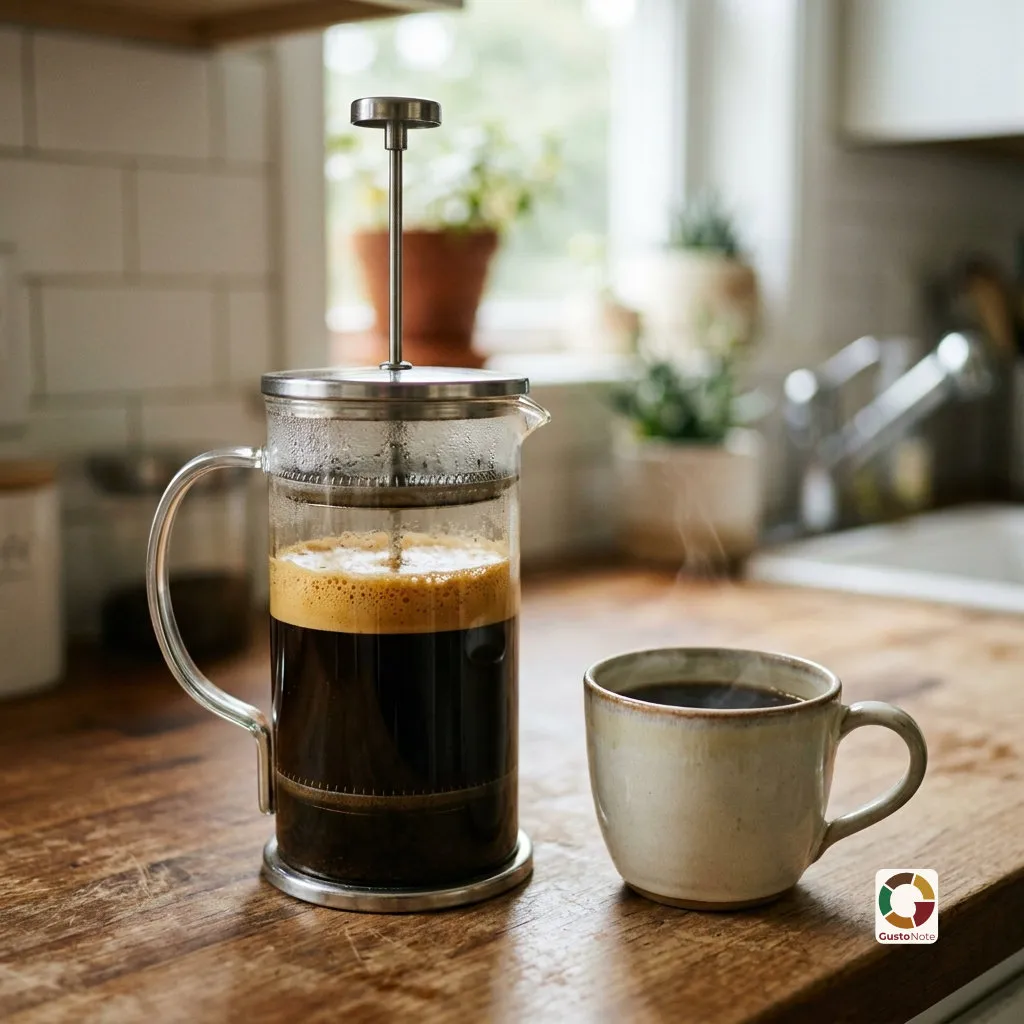
French press - the simplest road to good coffee
If I had to recommend one piece of equipment to someone who wants to start brewing better coffee without spending a fortune, it would be the French press. It is the simplest good method I know: no pressure, no paper filters, no complicated technique. You add coffee, pour water, wait and press the plunger. And despite this simplicity, the French press makes a full, rich, aromatic coffee, completely different from pour-over. The whole craft comes down to a few rules worth understanding once.
How the French press works
The French press is an immersion method. The coffee stays submerged in water for the whole brew, and at the end it is separated by the metal mesh of a pressed plunger. This is the key difference from pour-over, in which a paper filter traps oils and fines. Here the metal mesh lets through the natural oils and the finest coffee particles, which is why French press coffee is fuller, denser and oilier, with a clear body. These are two different styles: clean and clear pour-over versus full and substantial French press. I cover how the method affects body in the coffee tasting profile, and the pour-over method itself in pour-over V60 and Chemex.
Ratio, grind and water
Three settings decide the result:
- Ratio. A good starting point is around 1:15, for example 30 grams of coffee to 450 millilitres of water. Tune it stronger or weaker to your taste.
- Coarse grind. This is the most important rule of the French press. The coffee should be ground coarse and even, like coarse sea salt or breadcrumbs. Too fine a grind, with the long contact with water, gives a bitter, over-extracted brew and a tonne of sediment. I cover the role of grind in coffee grind size.
- Water. A temperature around 94 degrees, that is just off the boil, and good-quality water.
The classic method step by step
The simplest, reliable recipe goes like this. Add coarsely ground coffee, pour the water and start the timer. After about four minutes a crust of coffee forms on the surface. Break it with a spoon, stirring the top, and some of the grounds will sink to the bottom. Then press the plunger slowly and evenly, ideally over about twenty seconds, so as not to stir up the sediment. A slow plunge keeps the amount of grounds in the cup down.
One important tip: do not leave the brewed coffee on the grounds. If you plan to drink it over a longer time, decant it straight into a carafe or cups, because coffee left on the grounds keeps extracting and turns bitter.
The Hoffmann method, or coffee without sediment
A technique popularised by James Hoffmann is popular among coffee lovers and gives an exceptionally clean brew without pressing the plunger. After pouring the water you wait about four minutes, then break the crust and scoop off the foam and grounds floating on top with a spoon. Then you leave the coffee for a few more minutes, so the rest of the grounds settle calmly to the bottom. Finally you gently pour off the clear brew, barely moving the plunger. The result is a French press with far less sediment, combining the fullness of immersion with cleanliness.
When something is off
Taste is the best guide. If the coffee is bitter and astringent, that is over-extraction, so grind coarser or shorten the brew time, and be sure to decant the coffee off the grounds. If it is sour and thin, that is under-extraction, so grind finer or lengthen the time a little. I break down the bitter-versus-sour mechanism in coffee defects.
Note it and compare
You will refine your French press fastest by recording every brew. In GustoNote you note the ratio, grind, time and taste of every coffee, and after a few entries you will see which settings give you the best result for a given bean. It turns morning brewing into a repeatable, conscious ritual in which every coffee is better than the last. I cover the differences between methods in general in coffee brewing methods.