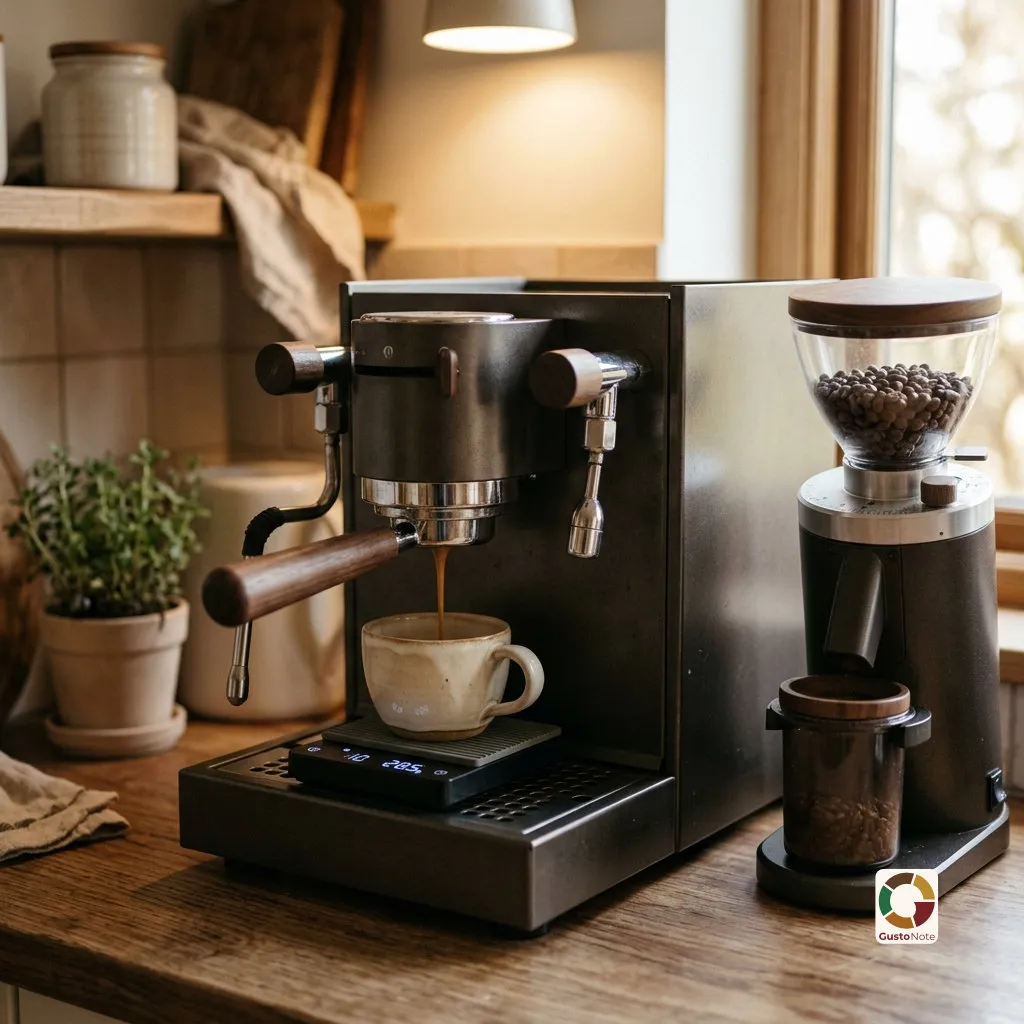
Home espresso - where to start
Home espresso can be a source of frustration: one time it comes out bitter, another sour, another thin, and you do not know why. Yet espresso is not a lottery but the most measurable brewing method we know. It is governed by a few simple variables, and once you understand them, you stop guessing and start setting the flavour on purpose. This post is a beginner’s guide: what you really need, where to put your budget, and how to methodically reach a good espresso.
What espresso actually is
Espresso is a method in which hot water is forced under high pressure, classically around 9 bars, through a layer of finely ground, compressed coffee. In a few dozen seconds a small portion of concentrated, dense brew is created, topped with crema. It is this high pressure that distinguishes espresso from pour-over and gives it its intensity and characteristic foam, which I cover in espresso crema.
The grinder matters more than the machine
This is the most important and most often ignored truth of home espresso. If you have a limited budget, spend more on a good burr grinder, not on an expensive machine. Espresso requires a very fine and very even grind, and cheap blade grinders, which smash the bean into an uneven dust, make even extraction impossible. Without a good grinder, even an expensive machine will not give a repeatable espresso. Grinding is the key variable, which I cover in coffee grind size.
The second requirement is fresh coffee, ideally ground just before brewing. Old, sitting coffee will not make a good espresso regardless of the equipment. I cover freshness in coffee freshness.
The three numbers that govern espresso
Professionals control espresso with three measurable quantities. All you need is a scale and a timer to take charge of them:
- Dose is the amount of dry coffee in the basket. For a double espresso, a safe start is around 18 grams.
- Yield is the mass of finished espresso in the cup. The golden standard is a 1:2 ratio, meaning from 18 grams of coffee we want to draw about 36 grams of drink.
- Time is how long the flow lasts. For a 1:2 ratio, aim for around 25 to 35 seconds from the first drop.
These three numbers, dose, yield and time, describe espresso better than any by-eye impression. Write them down, because they are what make espresso repeatable.
How to dial in the flavour step by step
The process of reaching a good espresso is called dialling in, and it rests on one iron rule: change only one thing at a time, the grind first. The reference point is the taste:
- If the espresso flows too fast and is thin, sour and sharp, that is a sign of under-extraction. Grind finer to slow the flow.
- If it flows too slowly and is bitter, astringent and woody, that is over-extraction. Grind coarser to speed up the flow.
Keep the dose and ratio constant and adjust the grind until the time and taste hit the spot. I break down the sour-versus-bitter mechanism in more depth in coffee defects. Only once you master the grind should you play with dose and ratio.
The small things that make a difference
Beyond the three numbers, it is worth attending to two technical actions. The first is even distribution of the coffee in the basket, so the water does not find an easier path on one side. The second is tamping, an even, perpendicular compression of the coffee with a tamper. An uneven or slanted bed creates channels through which water races, ruining the extraction. It is not magic, just evenness and repeatability.
Realistic budget and first steps
You do not have to start with equipment costing thousands. A sensible starting set is a decent burr grinder for espresso, a simple portafilter machine that holds pressure, a scale and fresh coffee from a local roaster. To begin, choose medium and darker roasts, because they forgive more mistakes than light, acidic beans. Over time, once you master dialling in, you will reach for lighter, more demanding coffees.
The fastest way to learn espresso is to record every attempt. In GustoNote you note the dose, yield, time, grind and taste of every espresso, and after a few dozen entries you will see which settings give you the best result for a given coffee. It turns a morning lottery into a repeatable, conscious process in which every cup is better than the last. I cover the differences between methods in coffee brewing methods.