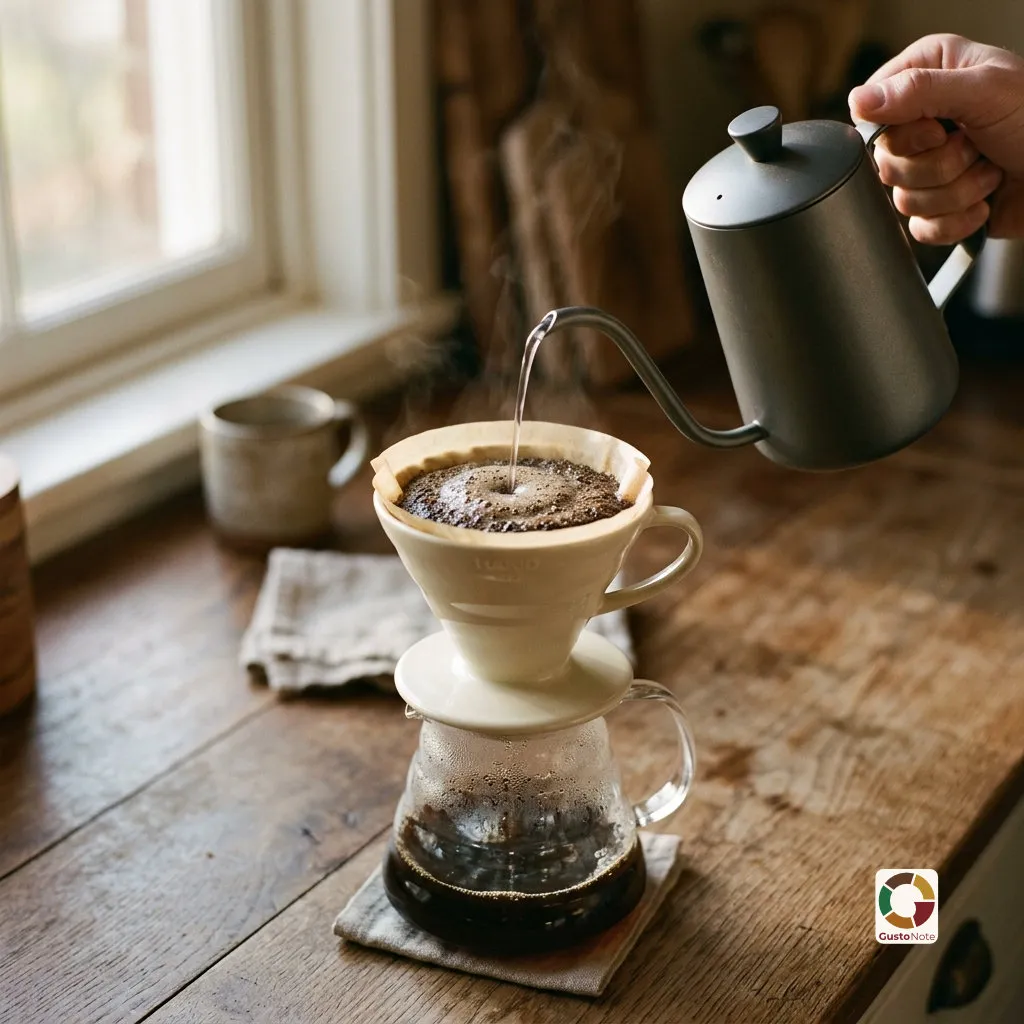
Pour-over V60 and Chemex - how to brew coffee step by step
For many people pour-over is the peak of home coffee brewing: simple equipment, no pressure, and in the cup a coffee that is clean, clear and full of nuance. It is a method in which water flows through a bed of ground coffee and a paper filter that traps oils and fines, giving a transparent drink, almost tea-like in texture. It sounds simple, but it is precisely this simplicity that exposes mistakes: bad coffee, a bad grinder or bad technique show up straight away in the cup. Here is how to brew pour-over methodically, on the two most popular drippers, the V60 and the Chemex.
How pour-over works
In pour-over there is no pressure like in espresso. The water simply flows by gravity through the coffee, and the paper filter traps oils and the finest particles. That is why pour-over coffee is clean, bright and clear, with acidity and aroma brought forward, in contrast to the dense, full body of French press coffee. I cover how the method affects body in the coffee tasting profile.
Ratio, grind and water
Three settings decide the flavour, and all can be measured with a scale:
- Ratio. The standard is 1:16, that is 60 grams of coffee per litre of water, for example 15 grams of coffee to 240 grams of water. A V60 is often brewed a touch stronger, around 1:15, and a Chemex in the 1:16 to 1:17 range. A stronger ratio gives a fuller body, a lighter one a more delicate, tea-like brew.
- Grind. Medium-fine for the V60, slightly coarser, medium-coarse, for the Chemex. Grind is the most important lever of flavour, which I cover in coffee grind size.
- Water. A temperature around 92 to 96 degrees and good-quality water, because it makes up almost the whole brew. I cover its role in water for coffee.
The bloom, or the crucial first step
We start with the so-called bloom, a pre-infusion. Pour about twice the weight of the coffee in water, so for 15 grams of coffee about 30 grams of water, and wait around 30 seconds. Fresh coffee then releases carbon dioxide, which swells and bubbles on the surface. This step matters, because gas trapped in the coffee would repel the water and hinder even extraction. A vigorous, swelling bloom is also a good sign of bean freshness, which I cover in coffee freshness.
How to pour the water
After the bloom, add water calmly, in circular motions from the centre outward, without flooding the coffee suddenly and without pouring down the sides. The aim is to wet the whole bed evenly, with no channels through which the water would take a shortcut. With a Chemex it is worth pouring in three additions, first the bloom, then two more portions, to keep the bed even and the temperature stable. The whole brew of a single serving in a V60 should take from around 2.5 to 3.5 minutes, while a larger Chemex can be slower, up to 5 minutes.
V60 versus Chemex
Both are pour-overs, but they give a different result, mainly through the filter and the flow rate:
- The V60 has a large opening and a thin, conical filter, so water flows faster. It gives a livelier, brighter coffee, with acidity and aroma brought forward. It does require a little more control over the pour, though.
- The Chemex uses a thick, dense filter, about thirty percent thicker than a normal one. This slows the flow and traps more oils and fines, giving an exceptionally clean, smooth, almost tea-like coffee, but usually with a lighter body. It is also more forgiving for beginners.
When something is off
Taste is the best guide. If the coffee is bitter and astringent, that is over-extraction, so grind coarser or shorten the time. If it is sour, thin and salty, that is under-extraction, so grind finer or lengthen the brew. Change one thing at a time. I break down the bitter-versus-sour mechanism in coffee defects.
Note it and compare
You will master pour-over fastest by recording every brew. In GustoNote you note the ratio, grind, time, equipment and taste of every coffee, and after a few dozen entries you will see which settings give you the best result for a given bean and whether you prefer the livelier V60 or the smoother Chemex. It turns morning brewing into a repeatable, conscious process. I cover the differences between methods in general in coffee brewing methods.