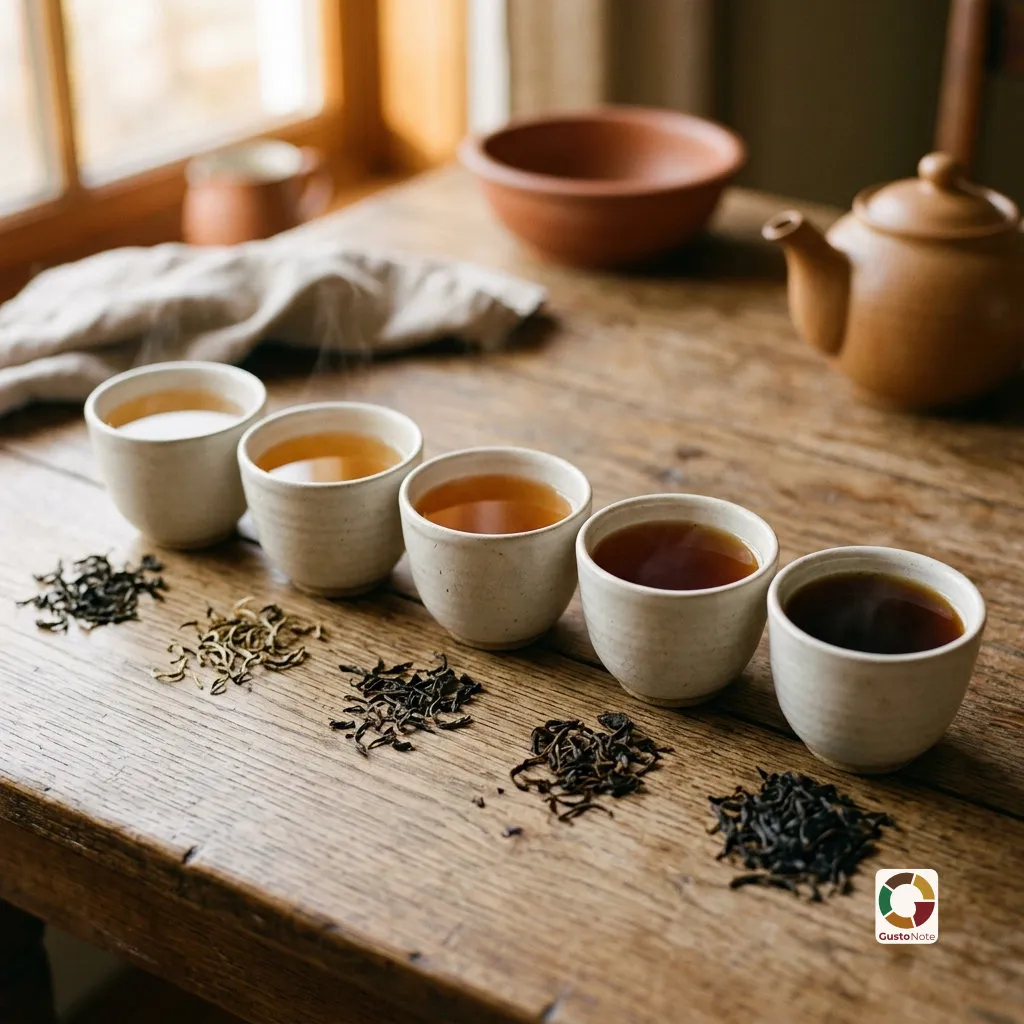
Black tea - Darjeeling, Assam, Ceylon and Yunnan
For many people black tea is just a strong, dark brew from a bag. Yet it is the most widely grown and most regionally varied type of tea in the world. They are united by full oxidation, which gives a dark colour, a bold flavour and low delicacy, and divided by origin, because tea from Indian Darjeeling tastes completely different from Chinese Yunnan. Getting to know these lands turns anonymous black tea into a map of specific, recognisable flavours. Here are the four most important regions worth knowing.
What makes a tea black
All teas come from the leaves of the same shrub, and what distinguishes black from green or oolong is full oxidation. After picking, the leaf withers, is rolled to release its juices, and then left to oxidise completely, until it changes colour to dark and flavour to bold, malty and honeyed. Only then is it dried to fix the result. I describe the oxidation mechanism in what oxidation is.
Darjeeling - the champagne of teas
Darjeeling grows high in the Indian Himalayas, on some of the highest plantations in the world, and is sometimes called the champagne of teas. Its trademark is the so-called muscatel flavour, a subtle combination of fruity and floral notes, associated with the muscat grape. Darjeeling is drunk above all in two seasonal forms:
- The first flush, from spring, gives a pale, fresh, floral brew, almost green in character, with a clear, crisp muscatel.
- The second flush, from summer, is fuller, smoother, more mature and amber, with a deeper muscatel.
It is a more delicate tea than most blacks, so it is brewed more carefully, for a shorter time and with cooler water.
Assam - malty strength
Assam comes from the hot, lowland valley of the same name in India, where abundant sun and a year-round season give a strong, substantial, full tea. Its trademark is maltiness, a deep, dark, almost bready flavour, often with notes of raisin and dried plum and a thick, sturdy body. It is Assam that forms the base of many classic breakfast blends, like English Breakfast, and as one of the few teas it takes a splash of milk beautifully.
Ceylon - citrusy liveliness
Ceylon is tea from Sri Lanka, a country with an enormous range of growing altitudes, which translates into different styles. The common denominator is a lively, bright character with a citrus note. High-grown teas are lighter, crisper and more aromatic, while those from lower plantations are stronger and fuller, with a sweeter, slightly fruity flavour. Ceylon is a versatile, everyday black tea, good both plain and with additions.
Yunnan - chocolate and honey
Yunnan, a region in south-west China considered the cradle of tea, gives some of the best black teas in the world, also known as Dian Hong. It is a strong but smooth and velvety tea, with a silky texture and a long, sweet aftertaste. Its trademarks are notes of chocolate, cocoa and honey, and the best varieties are full of golden buds. Yunnan is a black tea for those who like depth and sweetness without sharpness.
It is also worth mentioning Keemun from the Chinese province of Anhui, a full, smooth tea with notes of chocolate and wine, which forms the base of classic English blends.
How to brew black tea
Black tea, being fully oxidised, takes hotter water than green, usually around 90 to 95 degrees, and strong Assams even boiling water. A more delicate Darjeeling is better brewed for a shorter time and a little cooler, so as not to draw out excessive astringency. Strong, malty teas pair well with milk, while delicate, aromatic ones like Darjeeling or Yunnan are best drunk plain, so as not to drown their nuances. I cover matching temperature and time in how to brew tea.
How to explore black teas
The best way to feel the breadth of this world is to brew a delicate, muscatel Darjeeling next to a strong, malty Assam. The same type of tea, yet two completely different experiences. In GustoNote you note the region, profile and your impressions of every black tea, and after a few dozen entries you will see whether you lean toward the light, floral ones or the strong, malty and chocolatey ones. It turns anonymous black tea into a map of specific flavours you can navigate on purpose. I break down how to describe each tea’s profile in the tea tasting profile.