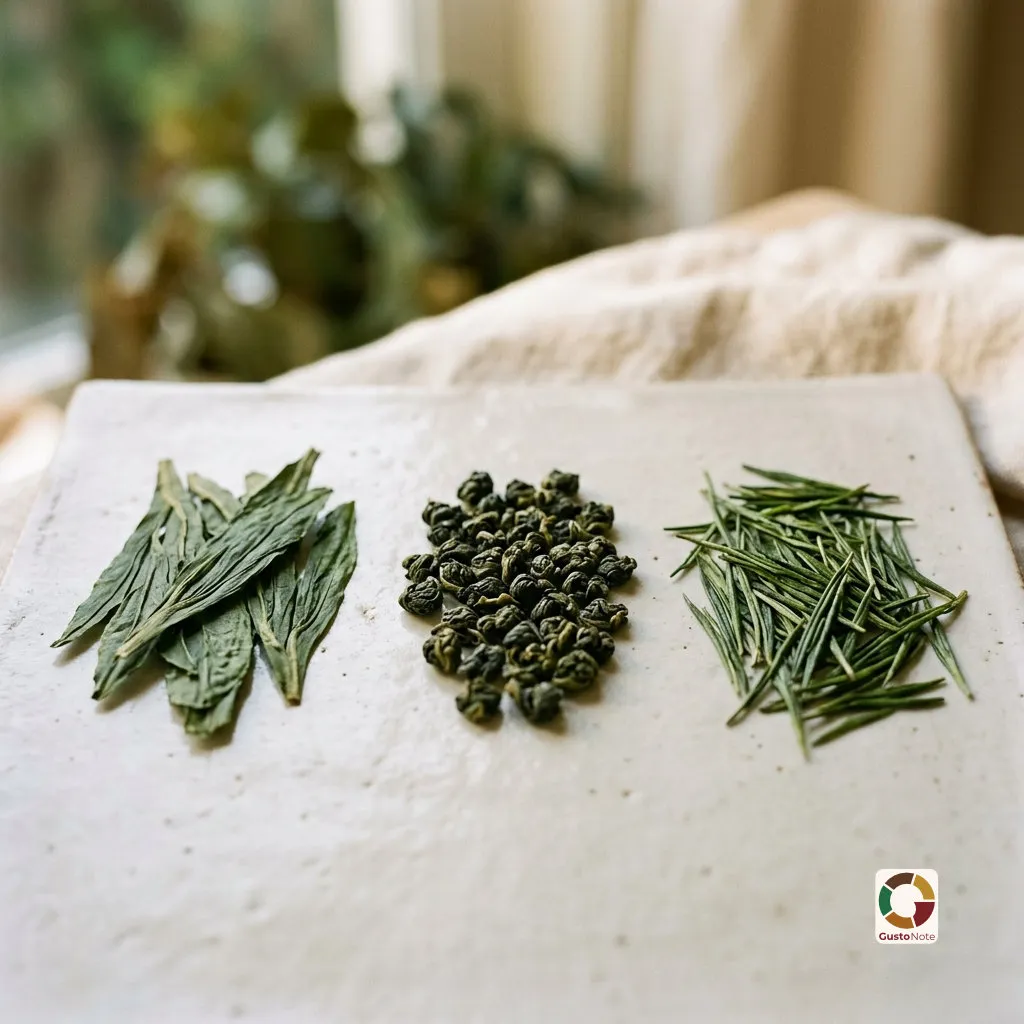
Green tea - sencha, gyokuro, gunpowder and longjing
For many people green tea means one not very inviting flavour: a bitter, grassy brew from a bag. Yet green is not a single flavour but a whole family of teas that can be sweet, nutty, floral, buttery or intensely umami. They all come from the leaves of the same shrub, Camellia sinensis, and share one thing: they are barely oxidised. What divides them is the way oxidation was stopped, and then the region, variety and processing of the leaf. Let us meet four classics that show how wide this world is: sencha, gyokuro, gunpowder and longjing.
What makes green tea green
Once picked, every tea leaf begins to oxidise, that is, to react with oxygen, which changes its colour and flavour. For tea to stay green, this process must be stopped very early, by heating the leaf and deactivating the enzymes responsible for oxidation. I describe the oxidation mechanism itself in what oxidation is. How exactly the oxidation is stopped is the most important divide in the world of green tea:
- Steaming, the Japanese method. The leaf is exposed to hot steam for a few dozen seconds. This gives teas with a vivid green colour and a fresh, vegetal, marine and umami character.
- Pan-firing, the Chinese method. The leaf is heated in hot, dry woks or drums. This gives teas with a warmer flavour, more nutty, roasted and toasty, and a yellow-green brew.
This one step, steam versus pan-firing, explains a huge part of the difference between Japanese and Chinese green tea.
Sencha - the everyday classic of Japan
Sencha is the most popular tea in Japan, making up the lion’s share of its production. The leaves grow in full sun, then are picked, steamed, rolled and dried. The result is a brew with a fresh, grassy, slightly marine aroma, a noticeable umami note and a refreshing, delicate astringency. A good sencha is like a spring meadow in a cup: green, lively, clean. It is a great starting point if you want to understand the Japanese style. It does, however, need careful brewing, because it turns bitter easily with water that is too hot.
Gyokuro - shade, umami and sweetness
Gyokuro is the aristocrat among Japanese teas and one of the most expensive green teas in the world. Its secret is shading: for about three weeks before harvest the bushes are covered with mats, cutting off most of the light. The plant responds by producing more theanine, an amino acid with a sweet, umami taste, and at the same time fewer catechins, which give bitterness and astringency. The leaf also accumulates more chlorophyll, turning dark green. The result is a brew with an extraordinarily intense, sweet, broth-like umami, almost free of bitterness, dense and deep. Gyokuro is brewed very cool, sometimes with water at just 50-60 degrees, to draw out the sweetness rather than the astringency. The same shading is used in making matcha.
Longjing - the Chinese dragon with a nutty flavour
Longjing, or Dragon Well, is probably the most famous Chinese green tea, from the area around Hangzhou in Zhejiang province. It is a pan-fired tea with distinctive flat, smooth leaves, pressed by hand against the walls of a heated wok. The flavour is completely different from the Japanese: nutty, chestnutty, sweet, buttery, with a delicate toasty note and no marine character. The brew is pale, yellow-green, mellow and pleasantly round. Longjing is a perfect example of how pan-firing turns the same plant into something warmer and more dessert-like than Japanese sencha.
Gunpowder - rolled pellets with a bold character
Gunpowder takes its name from its look: the leaves are rolled into small, hard pellets resembling grains of gunpowder. It comes mainly from Zhejiang province and is also pan-fired. It is a bolder, more decisive tea, slightly smoky, sometimes with a metallic note and a darker brew. The rolled pellets keep well in storage and transport, which is why gunpowder spread around the world. It is the tea traditionally used in Moroccan mint tea, brewed strong and sweetened. If sencha can be too delicate, gunpowder gives a clearer, sturdier flavour.
How to brew green tea
The most common mistake with green tea is drowning it in boiling water. Hot water rapidly releases catechins and tannins, giving a bitter, astringent brew that has put off many a drinker. Green tea likes cooler water and shorter steeping:
- Sencha and longjing - water around 70-80 degrees, steeping 1-2 minutes.
- Gyokuro - water even lower, around 50-60 degrees, steeping 1.5-2 minutes, for full umami.
- Gunpowder - tolerates a slightly higher temperature and stronger brewing, especially in the mint version.
Most good green teas can be brewed several times, and each successive infusion reveals a different layer of flavour. I break down how to match temperature and time to the type in how to brew tea, and where a bitter brew comes from in why your tea tastes bitter.
How to explore green tea
The best way to feel how wide this family is, is to brew two green teas side by side, for example a steamed sencha and a pan-fired longjing. The difference between marine umami and nutty sweetness is immediate and eye-opening. In GustoNote you note the type, origin, brewing parameters and profile of every tea, and after a few dozen entries you will see whether you lean toward the umami-rich Japanese style or the nutty, toasty Chinese teas. It turns a vague green tea into a map of specific flavours you can navigate on purpose. You will find a full overview of tea types in types of tea.