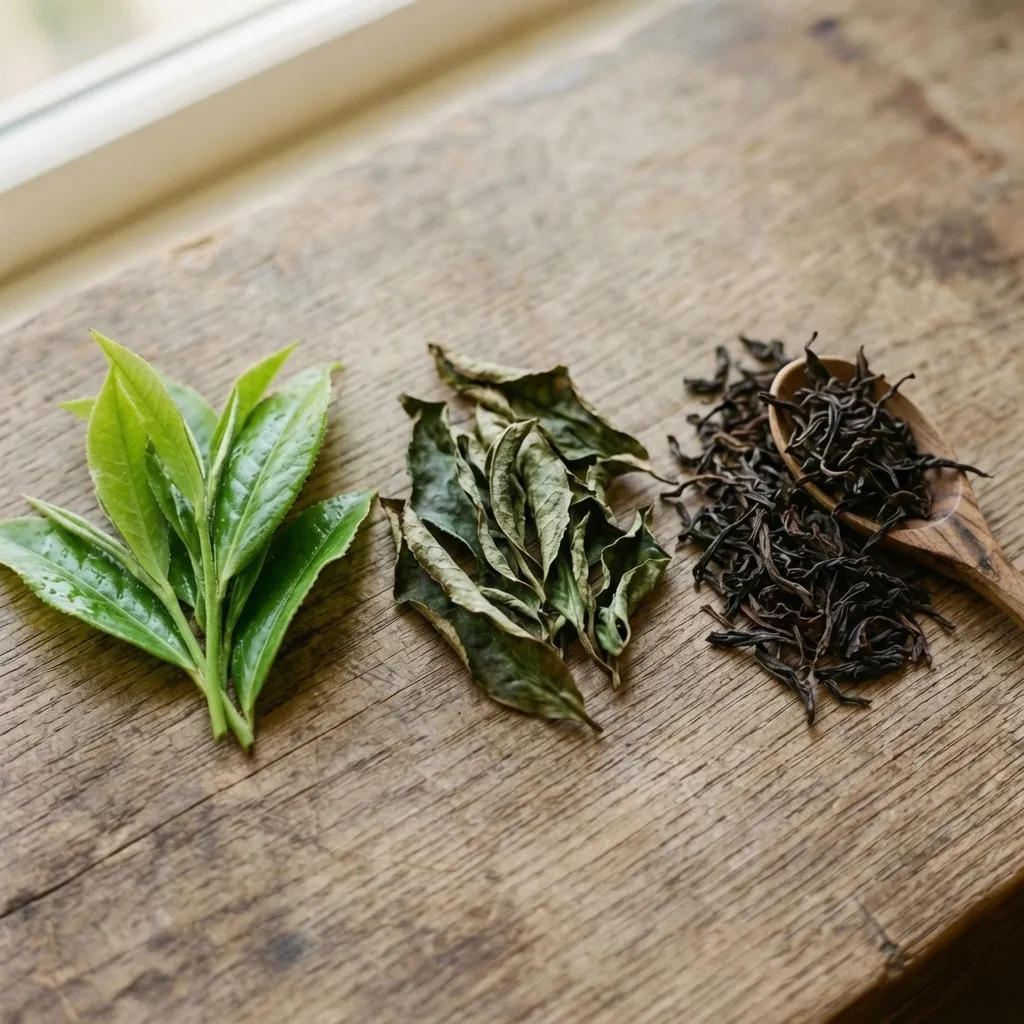
How tea is made - from leaf to cup
All the tea in the world, from delicate white to dark pu-erh, comes from the leaves of one shrub, Camellia sinensis. These are not different plants, only different ways of treating the same leaf. Once you know the steps of production, you stop confusing the types and start understanding why they taste so different. For an overview of the types themselves, see types of tea.
Five steps that make tea
- Picking - young leaves and buds are plucked. The gentler the harvest, the more refined the tea.
- Withering - the leaves lose some water and soften, which makes them ready for further processing.
- Bruising and rolling - the leaf is crushed or rolled, which breaks the cells and triggers flavour reactions. This is the moment oxidation begins.
- Oxidation - the leaf reacts with oxygen and changes colour and flavour. This is the most important step and the one that divides the tea types.
- Drying - strong heat stops oxidation and fixes the tea. After it, the leaf is ready to brew.
One step decides everything
How much oxidation the maker allows is what separates the tea types:
- White - barely oxidised, only withered and dried. The most delicate.
- Green - oxidation stopped very early by heating. Fresh, vegetal.
- Oolong - partly oxidised, somewhere between green and black. The widest range of flavours.
- Black - fully oxidised. Bold, malty, honeyed.
- Pu-erh - additionally fermented and aged, sometimes for years.
I unpack this mechanism in more detail in what oxidation is and why it divides teas.
From production to brewing
Since each type is made differently, each likes a different temperature and time. A delicate green will not survive the boiling water that does no harm to a black. How to match it is covered in how to brew tea. In GustoNote you note the type, origin and profile of every tea, and after a few dozen entries you will see which level of oxidation suits you best.