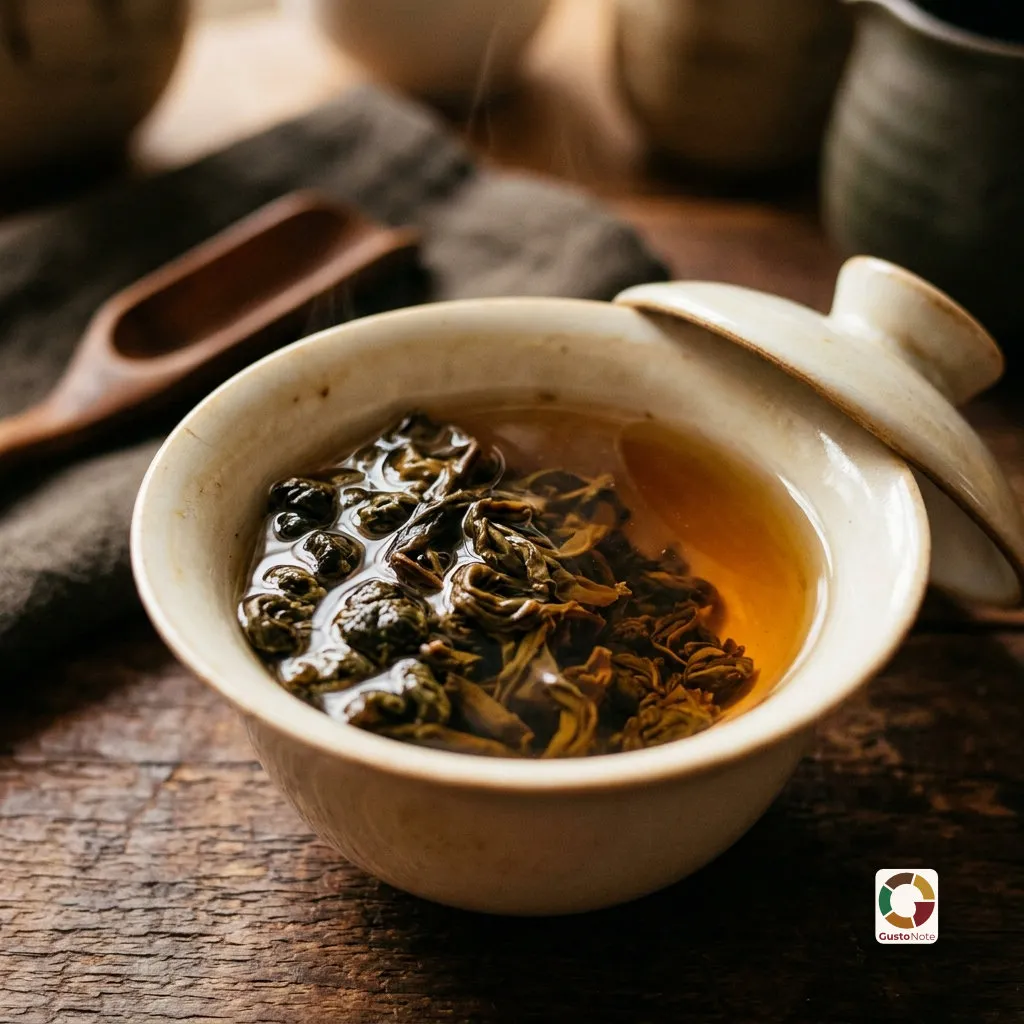
Oolong - the tea between green and black
If green tea is freshness and black tea is depth, oolong is everything in between, and that is exactly why it is the most fascinating, widest world of flavour in all of tea. Under one name hide teas that are floral and creamy, roasted and mineral, fruity and honeyed. This variety comes from one thing: oolong is partially oxidised, and the limits of that oxidation are very wide. For many tasters it is oolongs that are the peak of the tea adventure. They are worth knowing, because there is no other type of tea that offers such a sweeping palette.
What partial oxidation is
While green tea is oxidised minimally and black tea fully, oolong lies in between, usually in the range of around 10 to 85 percent oxidation. That is an enormous span, and it is what explains why oolongs taste so different. I describe the oxidation mechanism in what oxidation is.
The production of oolong is one of the most labour-intensive in the tea world. The leaf withers in the sun, then is gently shaken and bruised, so the edges of the leaf break and begin to oxidise while the centre stays green. The tea master repeats this cycle many times, controlling the level of oxidation precisely, until at the right moment he halts it with heat. Many oolongs are additionally roasted, which adds notes of caramel, nut and spice.
Light, floral oolongs
At one end of the spectrum stand lightly oxidised oolongs, green in character, rolled into small pellets:
- Tieguanyin, the Iron Goddess of Mercy from Anxi in Fujian, is today a classic light, floral oolong: an aroma of orchid and lilac, a creamy, buttery texture, a pale brew. A fact worth knowing: Tieguanyin used to be a dark, heavily oxidised and roasted tea, in the form of twisted strips. Only at the end of the 20th century did producers in Anxi switch to the light, green, floral style we know today. This shows that even one name can mean two different teas.
- Taiwanese high-mountain oolongs, or gaoshan, growing high in the mountains, give an exceptionally smooth, sweet, floral and creamy brew. Altitude, as with coffee, means slower growth and a more delicate, complex flavour.
Dark, roasted and honeyed oolongs
At the other end stand heavily oxidised and roasted oolongs, dark and deep:
- Wuyi rock teas, or yancha, including the famous Da Hong Pao, come from the rocky Wuyi mountains in Fujian. High oxidation and strong roasting give roasted, fruity, caramel and spicy notes, and above them floats a characteristic minerality the Chinese call the rock rhyme, yan yun. These are deep, long-resonating teas.
- Dong Ding from Taiwan is an oolong rolled into pellets but with deeper oxidation and roasting than the light gaoshan. It gives a warm, sweet, caramel flavour with a nutty base and a fuller body.
- Oriental Beauty, or Dongfang Meiren, is one of the most extraordinary teas in the world. Its secret is insects. The plantations are deliberately set at lower altitudes and kept free of pesticides, so that tiny leafhoppers can nibble the leaves. In response to the bites, the plant produces honeyed defensive terpenes, and the leaf itself begins to oxidise while still on the bush. The result is a heavily oxidised, honeyed, fruity tea with a natural sweetness that cannot be achieved any other way.
It is also worth mentioning Phoenix Dancong from Guangdong, oolongs in strip form famous for extraordinarily intense, almost perfume-like aromas that imitate the scents of flowers and fruit.
How to brew oolong gongfu style
Oolong shows itself most fully when brewed Chinese style, gongfu, that is, in a small vessel, with a large amount of leaf, in short, repeated infusions. It is the ideal method for oolong, because leaves rolled into pellets unfurl slowly over successive steeps, and each infusion reveals a different layer of flavour. A good oolong gives a dozen or more infusions, a real journey in a single portion of leaf. Oolongs are brewed with fairly hot water, usually around 90 to 95 degrees. I cover the art of multiple infusions in multiple tea infusions, and matching temperature and time in how to brew tea.
How to explore oolongs
The best way to feel the breadth of this world is to brew a light, floral oolong, for example Tieguanyin, next to a dark, roasted one like a Wuyi rock tea. The difference is so great that it is hard to believe they are the same type of tea. In GustoNote you note the level of oxidation, the roast, the origin and the profile of every oolong, and after a few dozen entries you will see whether you lean toward the light, floral ones or the dark, roasted and honeyed ones. It turns the vague name oolong into a map of specific flavours you can navigate on purpose. You will find a full overview of tea types in types of tea.