White tea - the least processed and most underrated
White tea is like the quiet outsider of the tea world: subtle, delicate and so unshowy on the first sip that it is easy to overlook. Yet it is the least processed tea of all, the closest to the raw leaf, and one of the few that can age for years like a good wine. Beneath the apparent plainness lies a brew that is sweet, floral, honeyed and surprisingly deep, if only you give it a chance and the right brewing. It is worth knowing, because it is a tea for the patient that rewards attention.
What makes a tea white
All teas come from the leaves of the same shrub, Camellia sinensis, and what differs is the processing. White tea takes the simplest path of all: the leaf merely withers, losing moisture, and then dries. There is no pan-firing or steaming, by which green tea deliberately stops oxidation. So white tea undergoes a gentle, natural oxidation, usually slight but nonetheless present. This makes it technically something between a green and a lightly oxidised tea. I cover the oxidation mechanism itself in what oxidation is.
Less processing also means the leaf must be of exceptional quality, because there is no way to hide faults. So white tea can be both the simplest to produce and the hardest to make well.
Where the name white comes from
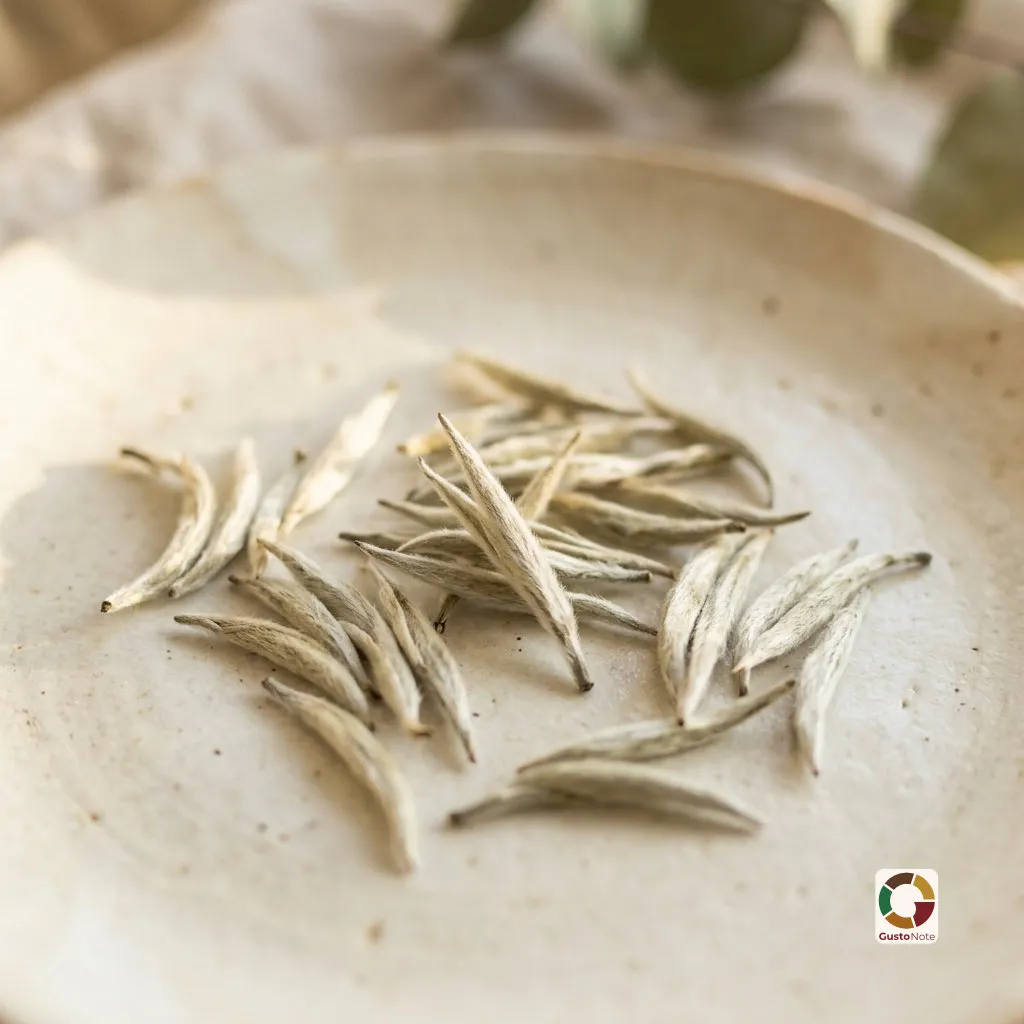
Despite the name, the brew of white tea is not white but pale yellow or golden. The name comes from the look of the dry leaf, specifically from the silvery-white down covering the young buds. These fine hairs, called trichomes, give the best white teas a fluffy, silver appearance. That is why the most famous white tea is called Silver Needle.
Three classics worth knowing
White tea is not one flavour but a family, depending on which part of the plant was picked:
- Silver Needle, or Bai Hao Yinzhen, is only unopened buds covered in silver down. The most prized and expensive white tea. The brew is delicate, sweet, with notes of hay, melon, honey and flowers. Mellow, light, almost ethereal.
- White Peony, or Bai Mudan, is the bud together with one or two young leaves. It gives a fuller, more expressive, fruity and floral brew, with a slightly nutty depth. A great entry point, because it combines delicacy with a readable flavour.
- Shou Mei and Gong Mei are teas from a later, larger leaf harvest. They are darker, stronger, sturdier and best suited to ageing.
The homeland of white tea is the Chinese province of Fujian, especially the Fuding and Zhenghe areas, though today it is also made in other regions of the world. You will find a full overview of tea types in types of tea.
A tea that ages for years
White tea is one of the few that, over time, not only does not lose but gains. Well stored, especially in pressed cakes, it deepens over the years: the fresh, floral notes give way to honey, dried fruit and warm, mature aromas. The Chinese capture this in a saying that white tea is tea in the first year, medicine after three years, and treasure after seven. This places it alongside pu-erh among collectible teas. I cover which teas to drink fresh and which are worth setting aside in freshness or age.
The no-caffeine myth
You often hear that white tea has the least caffeine. This is false and one of the most stubborn tea myths. Caffeine content depends more on the leaf material than on the colour of the tea, and the young buds used to make Silver Needle are actually rich in caffeine, because the plant concentrates it in its youngest parts as a natural defence. So a white tea that is delicate in flavour need not be low in caffeine. I cover how caffeine works in tea and why it stimulates differently from coffee in caffeine in tea.
How to brew white tea
White tea is delicate, but contrary to appearances quite forgiving, because it has low astringency. A few rules:
- Temperature around 80-85 degrees for delicate Silver Needle and White Peony. Older, aged white teas and Shou Mei tolerate hotter water.
- Time longer than you might think. Since white tea barely turns bitter, you can brew it for a good few minutes to draw out the sweetness and body.
- Multiple infusions are its element. Good white teas give several brews, each revealing a different layer.
I break down how to match temperature and time to the type in how to brew tea.
How to explore it and note it
The best way to appreciate white tea is to take your time and compare it next to a stronger tea, for example Silver Needle beside a green sencha. The subtlety of the white then becomes a virtue, not a flaw. In GustoNote you note the type, origin, vintage, brewing parameters and profile of every white tea, and with ageing examples you will see how their flavour changes over the years. It turns quiet, underrated white teas into a fascinating, long-term adventure for the palate.