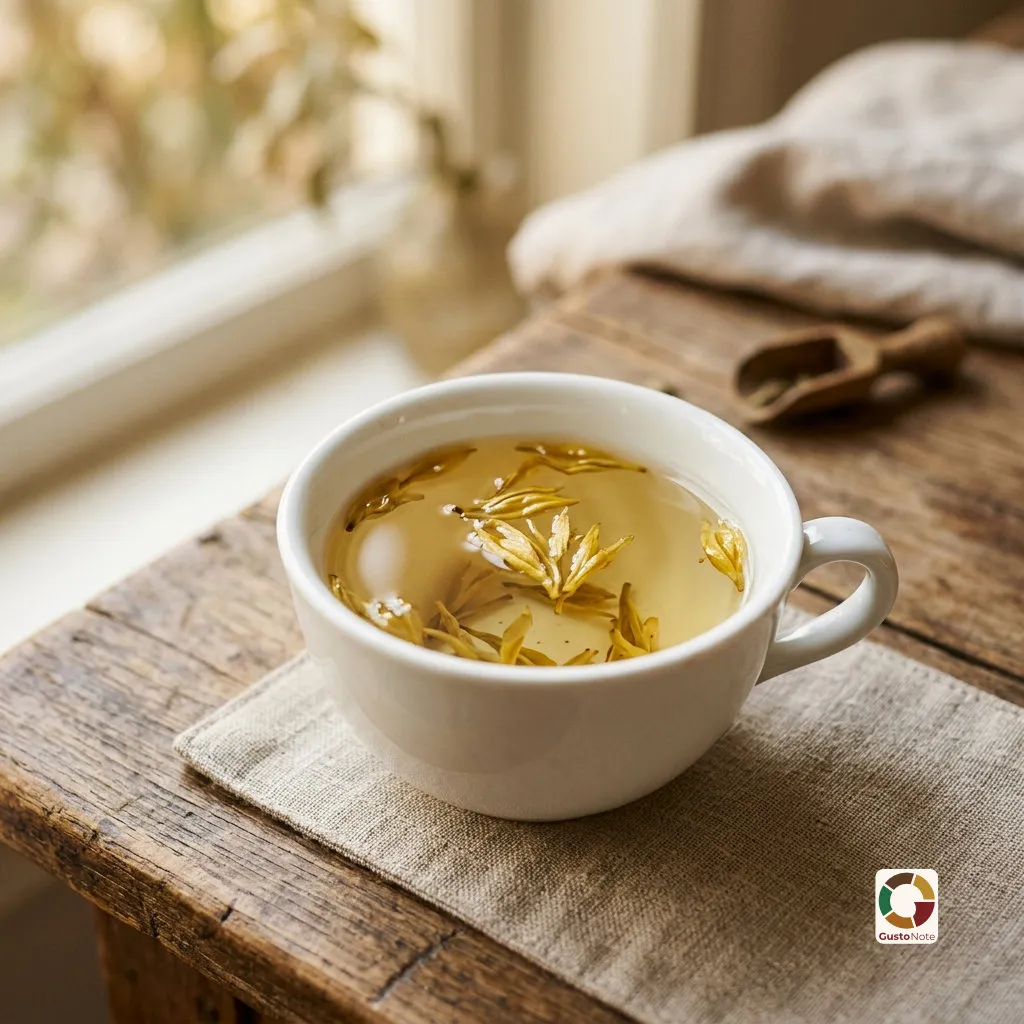
Yellow tea - the rarest of the six types
Yellow tea is the rarest and least known of the six great types of tea. Many enthusiasts drink it only a handful of times in their lives, and plenty of shops do not stock it at all. Which is a shame, because it is a tea with an exceptional history, going back over two thousand years, once reserved for emperors. On the surface it resembles green tea, but an extra, labour-intensive production step gives it a mellower, sweeter and more rounded character. It is worth knowing, if only to understand how subtle tea can be.
What makes a tea yellow
Yellow tea starts like green: the leaf is picked and heated to stop oxidation. I describe the oxidation mechanism in what oxidation is. Here, though, comes an extra, unique stage that no other type of tea has: yellowing, in Chinese men huang, which roughly means smothering yellow.
After the initial heating, the still-warm and slightly moist leaves are wrapped in an insulating but breathable material, for example paper or cloth, and left for a time. In the warmth and humidity the leaf gently re-heats and oxidises slightly, and this process is repeated over many hours, sometimes up to three days, with reheating in between. Finally the tea is slowly dried. This slow dance of heat and moisture turns the sharp, grassy character of green into something gentler.
Why it is so mellow and sweet
The result of the yellowing is a tea free of the raw, grassy note that some people see as a fault of green tea. Yellow is smoother, sweeter, more rounded, with minimal astringency. Typical notes are chestnut, warm grain, corn, honey and a gentle floral quality, and the brew is silky and soft. It is a tea for those who like green tea but are sometimes bothered by its sharpness, and for anyone who values subtlety over intensity.
Three classics worth knowing
Though there are few yellow teas, three of them are considered the canon:
- Junshan Yinzhen, the silver needles of Jun mountain, from an island in Dongting Lake in Hunan province. It is a bud-only tea, historically sent to emperors as a tribute tea. Today it is produced in very small quantities, most of which does not leave China.
- Huoshan Huangya from Anhui province, made from tender buds and young leaves picked in early spring, with a silky, softly sweet brew and notes of chestnut, warm grain and corn.
- Mengding Huangya from Sichuan province, historically described as one of the earliest and most representative yellow teas.
Why it is so rare
The rarity of yellow tea has two causes. First, the yellowing stage is labour-intensive, time-consuming and demands great experience, so few producers can and want to do it well. Second, many makers over time switched to the easier and more profitable green tea, abandoning the traditional methods. As a result yellow tea has become a niche within a niche, prized by connoisseurs but hard to find.
How to brew it
Yellow tea is brewed much like a delicate green: with water at around 80 to 85 degrees, not boiling, which would destroy its subtlety. A short brew draws out the sweetness and mellowness, and good yellow teas can be brewed several times, revealing successive layers. I cover matching temperature and time in how to brew tea, and the related green in green tea.
How to explore it
The best way to appreciate yellow tea is to compare it next to a green, ideally from a similar region. Then you will most clearly feel how the yellowing softened the grassy sharpness, leaving sweetness and smoothness. In GustoNote you note the type, origin, brewing parameters and profile of every yellow tea, and after a few entries you will see whether this subtle, rare category suits your taste. It turns a mysterious, hard-to-find tea into a conscious element of your tea map. You will find a full overview of types in types of tea.