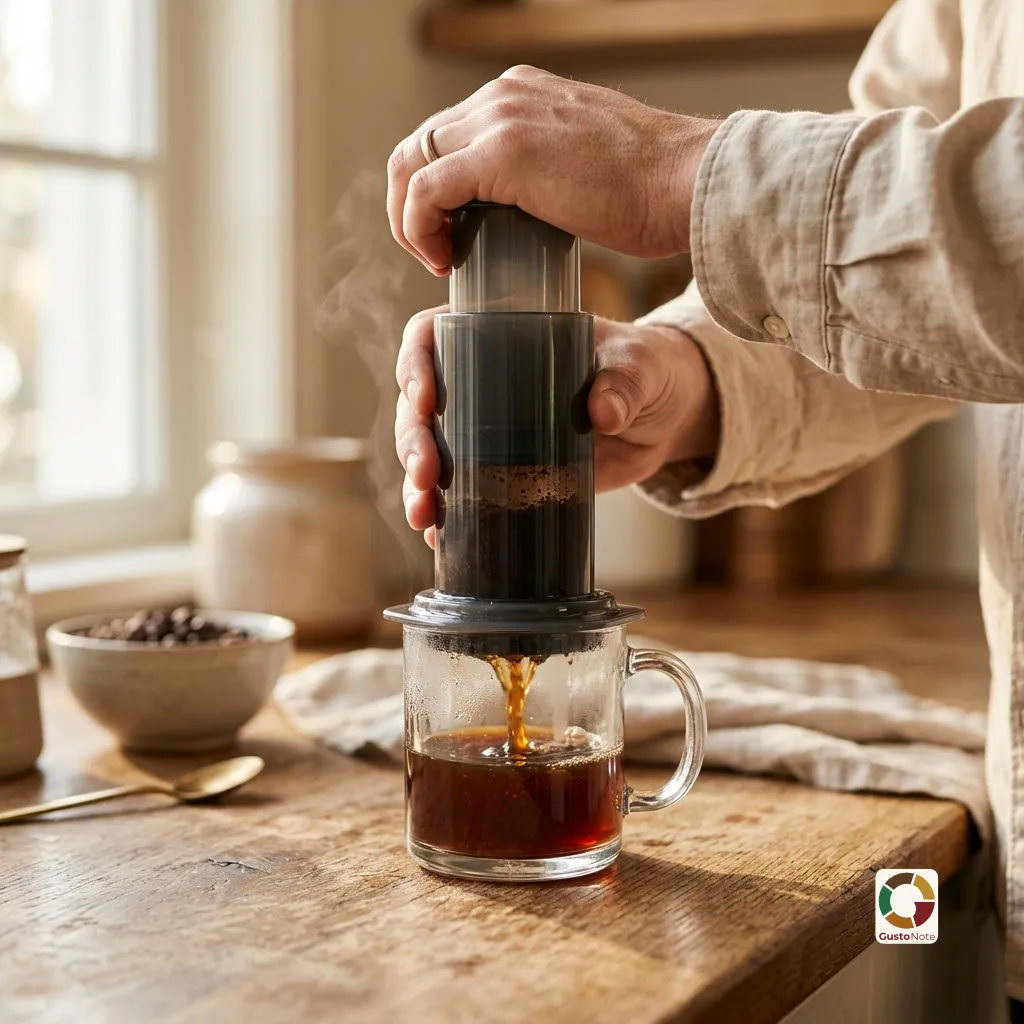
AeroPress - one device, a hundred recipes
The AeroPress is one of the most iconic and most versatile coffee devices ever made. It was invented in 2005 by Alan Adler, an engineer previously known for flying toys, and his simple plastic cylinder with a plunger has won devoted fans around the world, even with its own championship. The secret lies in its flexibility: from one cheap and indestructible device you can pull both a dense, espresso-style concentrate and a light, clean, almost tea-like coffee. It is the perfect device for the flavour tinkerer and for the traveller.
How the AeroPress works
The AeroPress combines two methods in one. On one hand it is immersion, coffee steeped in water, as in the French press. On the other, at the end of the brew you press the plunger, adding gentle pressure that pushes the water through the coffee and a paper filter. The paper filter traps oils and fines, giving a cleaner coffee than a French press, and the short brew time and pressure let you extract a lot of flavour in a minute or two. This combination of immersion, pressure and a filter is what makes it so flexible.
Standard method versus inverted
In the AeroPress world there is an eternal debate over two brewing methods:
- The standard method is the device set up with the plunger at the bottom and the filter over the cup. The coffee starts dripping straight away, and at the end you press the plunger. It is simpler, safer and less prone to accidents.
- The inverted method is the AeroPress set up upside down, with the plunger at the bottom and the open chamber facing up. Nothing drips before time, so you have full control over the steep time, and the coffee is more concentrated and even. The downside is the risk of spilling hot coffee when you flip it, if the seal slips.
In practice the difference in flavour is small, and both methods make excellent coffee. Many people start with the standard for safety and move to the inverted when they want more control.
Ratio, grind and water
The AeroPress is forgiving, but it is worth keeping a starting point:
- Ratio. A good start is around 1:15 to 1:16, for example 15 to 17 grams of coffee to 240 to 270 grams of water. Want it stronger and more of a concentrate, go toward 1:14, want it lighter, toward 1:17.
- Medium-fine grind, roughly like fine table salt, that is finer than for a French press and coarser than for espresso. I cover the role of grind in coffee grind size.
- Water around 80 to 90 degrees. A lower temperature softens acidity and bitterness, which can be an advantage with light roasts.
Why there is no single best recipe
Here lies the AeroPress’s greatest strength. Grind, water temperature, steep time, pressing force and any dilution of the finished coffee with water all interact, giving an almost infinite number of combinations. That is why there is no single best recipe, and at the World AeroPress Championship the winning recipes can be extreme and surprising. It is an invitation to experiment: the same coffee can taste completely different depending on the settings. I break down the bitter-versus-sour mechanism that helps you tune in coffee defects.
Who the AeroPress is for
The AeroPress is a great choice for three groups. For beginners, because it is cheap, simple and forgiving. For experimenters, because it offers an endless field to play in. And for travellers, because it is light, plastic and practically indestructible, so you can take it into the mountains or on a trip without worry. It is one device that replaces several methods.
Note it and compare
You will master the AeroPress fastest by recording every recipe. In GustoNote you note the ratio, grind, temperature, time and taste of every coffee, and after a few dozen entries you will see which settings give you the best result for a given bean. It turns the chaos of a hundred recipes into an organised collection of proven ones. I cover the differences between methods in general in coffee brewing methods.