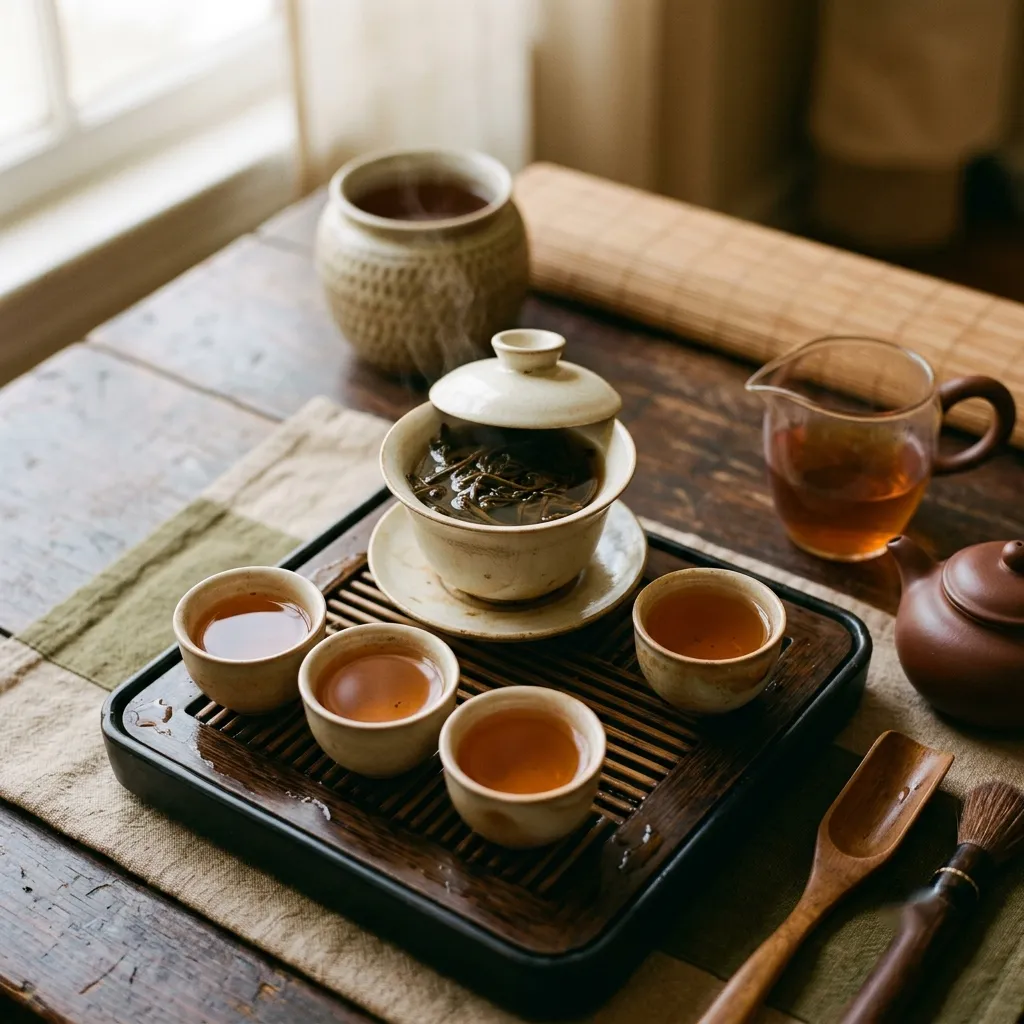
One tea, many infusions - how to steep loose leaf again and again
Most of us pour water on tea once, drink it and throw the leaves away. Yet good loose-leaf tea holds several, sometimes a dozen infusions, and each one tastes a little different - it is like listening to a whole album rather than one chorus. Multiple steeping needs no ceremony and no expensive gear, just a different approach.
Why leaves give more than one infusion
Whole leaves release their flavour gradually. The first infusion pulls the lightest, most volatile notes, the next ones reveal deeper layers: sweetness, body, minerality. That is why rolled or pressed leaves, like oolong or pu-erh, can work for a long time and unfold infusion by infusion. Teas made of finely broken leaves, as in most bags, give everything at once and a second infusion makes no sense. Why leaf beats the bag: leaf or bag.
Less water, more leaf, short steeps
The secret of multiple steeping is to flip the Western ratio. Instead of a little leaf in a big mug for a long time, put plenty of leaf in a small vessel and steep briefly, fifteen to thirty seconds. A stronger dose of leaf and a short time mean one steep does not exhaust the flavour and leaves some for the next.
Lengthen the time with each infusion
With every steep the leaves give less, so you make up for it with time. Keep the first infusion short, the second similar or even shorter, since the leaves are already open, and from the third add a few or a dozen seconds each time. There is no fixed table - follow the taste and stop when the brew turns empty.
Which teas work
Whole-leaf teas handle multiple steeping best: oolong, the master of the genre, which easily gives five to six infusions, then pu-erh, good green and white, and whole-leaf black. Very fine and heavily flavoured teas do worse. For the types of tea, look here: white, green, oolong, black.
How the taste changes
This is the most interesting part. The first infusion can be floral and light, the second the fullest and sweetest, the third and fourth show body, minerality and aftertaste, the last ones turn delicate and quiet. The same tea tells a story in several acts - and only by drinking it this way do you really get to know it.
You do not need a gaiwan
Traditionally a gaiwan or a small teapot is used, but to start any small vessel with a strainer will do, as long as you can pour the brew off quickly, so the leaves do not steep longer than you want. The principle is what matters: lots of leaf, little water, short, many times. The rest you pick up along the way.
Note each infusion and learn your leaves
Multiple steeping tastes best when you pay attention to how the brew changes - and notes help with that. In GustoNote you record the tea, ratio and time, and for each infusion mark on the wheel how the taste shifts: from floral, through sweet, to mineral. After a few sessions you know how many infusions your favourite leaves will give and when they peak.