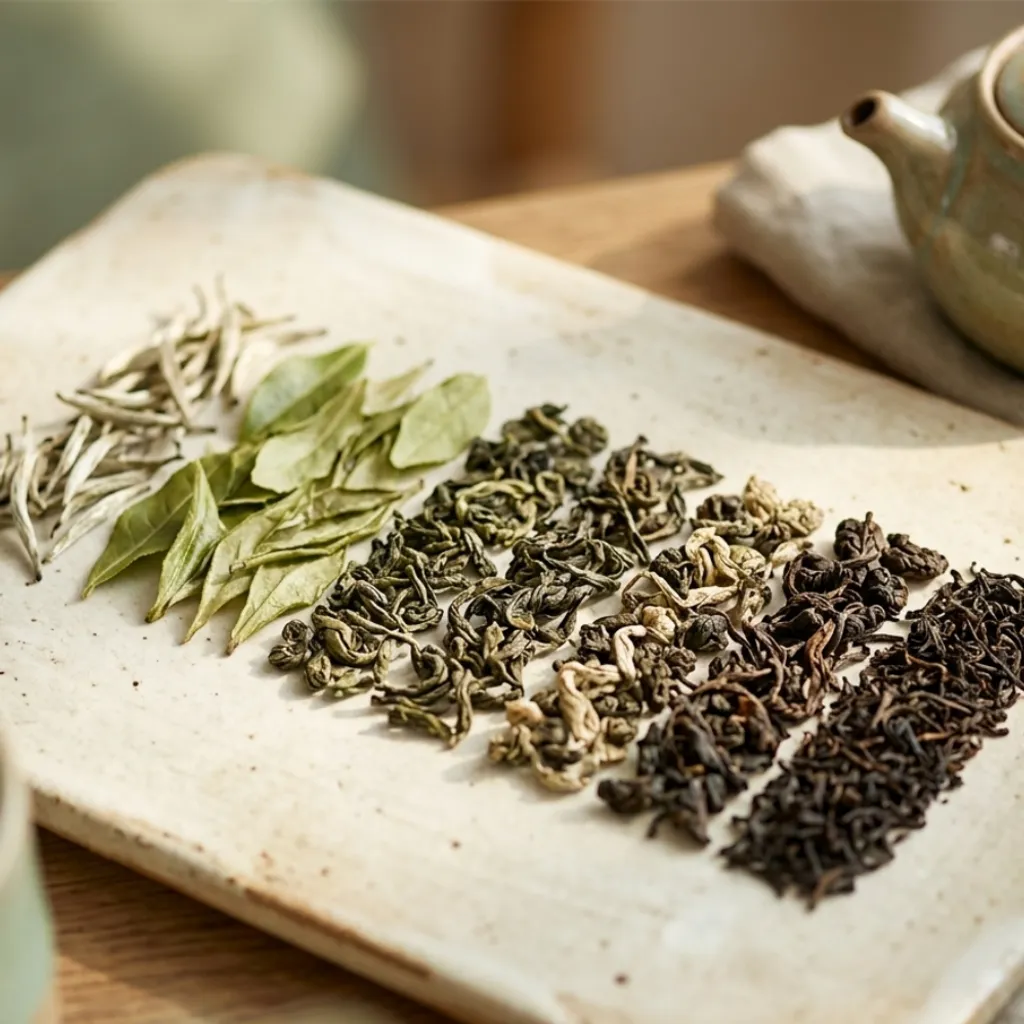
White, green, oolong, black - all tea comes from one bush
You walk into a tea shop and see dozens of names: white, green, yellow, oolong, black, pu-erh. It is easy to think these are different plants. Yet the truth is surprising: almost all of them come from one bush - Camellia sinensis. What sets them apart is, above all, how far the leaf is oxidised after harvest. Grasp that one thing and the whole map of teas suddenly falls into place.
Oxidation - the key to everything
Once picked, the tea leaf begins to oxidise (loosely: „ferment") - just as a cut apple browns. The producer controls this process: stopping it early, late, or somewhere in between. The more oxidised the leaf, the darker the brew and the stronger, „heavier" the taste. It is one axis on which all the types sit - from barely touched white to full black.
White - the least processed
Only withered and dried, almost unoxidised. The most delicate of teas: subtle, slightly sweet, with notes of hay, melon, flowers. Brew with cool water (75-85°C), because it is easy to „scorch".
Green - fresh and vegetal
Oxidation stopped at once (by heating the leaf). Hence the green colour and fresh, vegetal character. Two great schools:
- Chinese (pan-fired) - nutty, slightly smoky, „roasted chestnuts".
- Japanese (steamed) - intensely green, marine, grassy, with pronounced umami (especially sencha, gyokuro).
The most sensitive to water that is too hot - this is where bitterness most often comes from.
Yellow - green’s rare cousin
Similar to green, but with an extra, slow „smothering" step that softens the edge. Gentler, rounder. Rare and usually pricier.
Oolong - a whole world in between
Partly oxidised - and here lies an enormous range, from almost green to almost black:
- Lightly oxidised - floral, creamy, buttery (e.g. Taiwanese high-mountain oolongs).
- Heavily oxidised / roasted - toasty, nutty, caramel, with notes of dried fruit.
Oolongs are also masters of multiple infusions - good leaves brew five or more times, each steep tasting a little different.
Black - full strength
Fully oxidised (the Chinese call it „red"). Strong, malty, with notes of honey, dried fruit, chocolate, sometimes smoke. This is the one most often taken with milk. It tolerates hotter water (90-95°C) and a less nervous hand at brewing.
Pu-erh - the tea that ages
A category of its own: tea put through microbial fermentation and ageing, sometimes for years. Earthy, forest-floor, woody, deep - strange to some, addictive to others. Often pressed into „cakes" and, like wine, it can improve with age.
And herbs, fruit, rooibos?
An important note here: fruit and herbal brews, mint, chamomile or rooibos are formally NOT tea - they do not come from Camellia sinensis. They are „infusions". Most have no caffeine and follow their own rules - which is why they do not fear boiling water and long steeping.
Match the brewing to the type
Each type likes a different temperature and time - the more delicate (white, green), the cooler the water and the shorter the steep. We laid it all out in why your tea tastes bitter.
Record and discover your type
The best way to find your tea is to try different types and note your impressions. That is why GustoNote exists: you record every tea with its type and brewing parameters, mark the notes on a flavour wheel, rate astringency, sweetness and body - and after a dozen entries you see in black and white whether you gravitate to marine Japanese greens, floral oolongs or earthy pu-erhs. And next time in the shop you know what to look for.