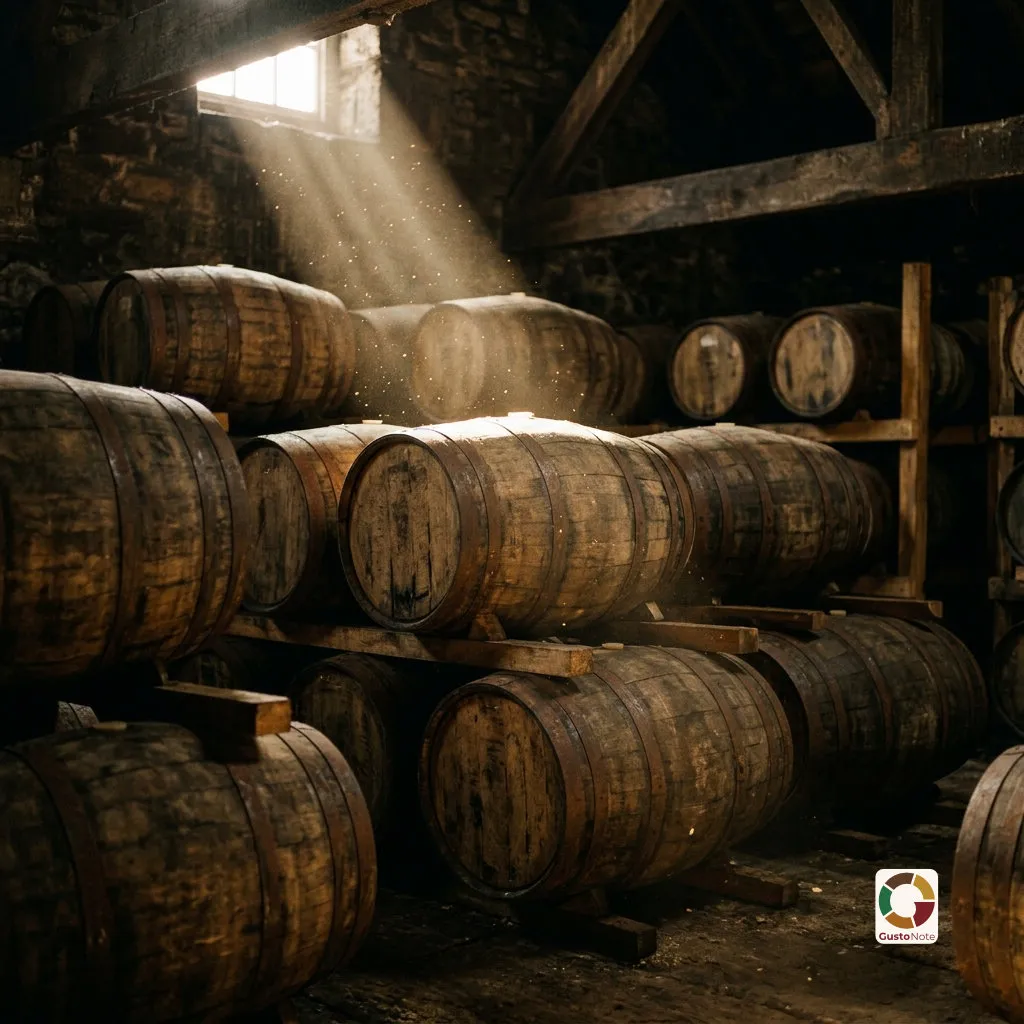
The angel's share - why whisky vanishes from the barrel
In Scottish warehouses they say the angels take a portion of the whisky. It is not just a pretty legend but a real process. Every year a few percent of the liquid disappears for good from each barrel, evaporating through the wood. This loss is called the angel’s share, and it affects the flavour and price of whisky more than you might think.
What actually disappears
An oak barrel is not sealed like glass. The wood breathes, and the whisky slowly evaporates through its pores. In the Scottish climate, around 2% of a barrel’s contents escapes each year. After a decade that is a significant amount, and after twenty or thirty years a full barrel holds surprisingly little. The angels take their share every year, whether or not anyone ever buys that whisky.
Why it depends on the climate
The rate of evaporation depends on the warehouse’s humidity and temperature:
- In cool, damp Scotland it is mainly alcohol that escapes, so the strength of the whisky drops slightly over time and the liquid becomes mellower.
- In a hot climate (Kentucky, India, Taiwan) the losses are far greater, reaching even into the double digits per year, and water evaporates more often, so the strength can rise.
That is why whisky from hot countries usually matures faster but loses more liquid along the way.
How it affects flavour
The angel’s share is not only a loss. The barrel’s slow breathing and contact with air smooth the whisky, concentrate the aromas and let the wood give up more vanilla, honey and dried fruit. It is part of why people say the cask makes the whisky. I expand on this in how the cask shapes whisky, and I describe the making process itself in how whisky is made.
Why old whisky is expensive
Now it is clear. An 18-year-old barrel holds far less liquid than a young one, and the producer kept capital sitting in the warehouse for all those years instead of selling it. Fewer bottles per barrel plus years of waiting equals a higher price. Age alone does not guarantee quality, though, which I cover in is older whisky better.
Note what you drink
In GustoNote you note the age, strength and profile of every whisky, and after a few entries you will see whether older, longer-matured bottles really suit your taste, or whether you prefer younger, livelier whisky.