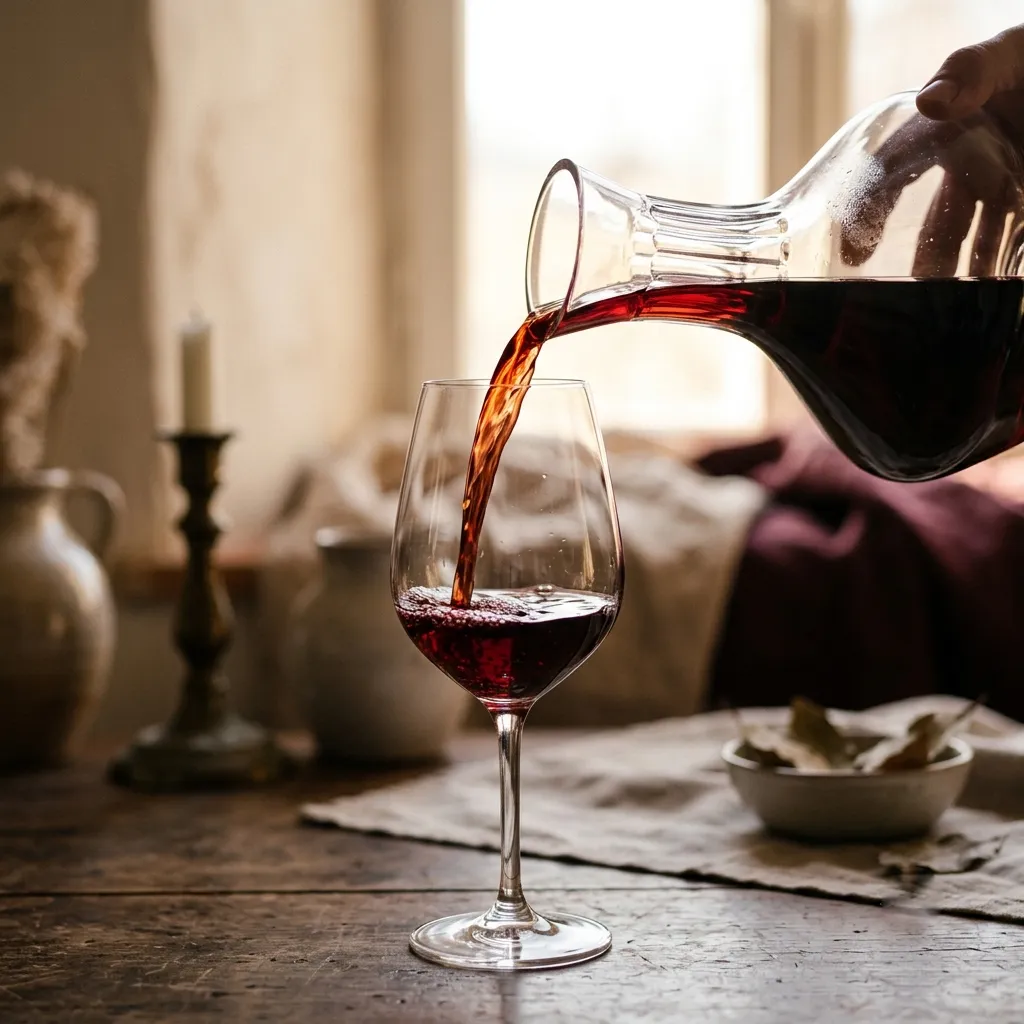
Should you decant wine - when it really helps and when it is theatre
A decanter looks like restaurant theatre and a touch of snobbery. In reality decanting is a simple thing that sometimes genuinely improves a wine and sometimes does nothing at all. The trick is knowing which case is in front of you.
These are two different things
One word hides two completely different goals that are easy to confuse:
- Aeration. You pour the wine into a decanter so it meets air. Oxygen opens up the aromas and softens a young, tight wine.
- Separating the sediment. You pour an old wine slowly so the sediment that has settled over the years stays behind in the bottle.
The first is about young, powerful wines. The second is about old, delicate ones. That is exactly why there is no single rule for everything.
Young, powerful reds: aerate freely
A young wine packed with tannins (Barolo, Bordeaux, a big Syrah, a young Spanish red) can feel closed and rough on opening. Contact with air works like a warm-up: the tannins soften, and instead of raw alcohol the nose fills with fruit and spice. Here a decanter really helps. Pour the whole bottle confidently, splashing is fine - the more air, the better. Such a wine usually needs anywhere from 30 minutes to two hours.
No decanter? Pouring into a large glass and waiting works partly too, just more slowly.
Old, mature wine: gently and without rushing
With wines aged 15-20 years it is the opposite. Their aromas are fragile and fleeting - too much air can blow them away in minutes. Here you use the decanter only to leave the sediment behind. Pour slowly, against a light, and stop when you see the sediment reaching the neck. Drink this wine right away, not an hour later.
The worst mistake is treating an old, delicate wine like a young one and leaving it in the decanter for two hours. That really will kill it.
White and sparkling
Most whites do not need a decanter. The exception is full, oaked whites (a mature white Burgundy, for example), which can gain from a short aeration. Never decant sparkling wine - you will lose the bubbles, the whole reason we love it.
What decanting will NOT fix
An important line: air opens a wine, but it does not undo faults. If a bottle is corked (wet cardboard, musty cellar) or thoroughly oxidised, a decanter will not save it - the fault stays, and sometimes becomes more obvious. So it pays to know how to spot a faulty wine before you blame the lack of decanting.
The simplest cheat sheet
- Young, tannic reds - yes, aerate, 30-120 minutes.
- Old, delicate reds - yes, but only for the sediment, and drink straight away.
- Light reds and most whites - not needed.
- Full oaked whites - a short aeration helps.
- Sparkling - never.
- A faulty wine - a decanter will not help.
Test it on yourself
Theory is theory, but you learn most by comparing the same wine fresh and after an hour. Pour two glasses: one right after opening, one after decanting, and smell them side by side. The difference can be surprising. To remember it, write down your impressions - in GustoNote you note for every tasting whether you decanted and how the wine changed over time. After a few bottles you will sense which wines are worth pouring out and which go straight into the glass. And if you are still learning to name what you smell, calibrating your palate helps.