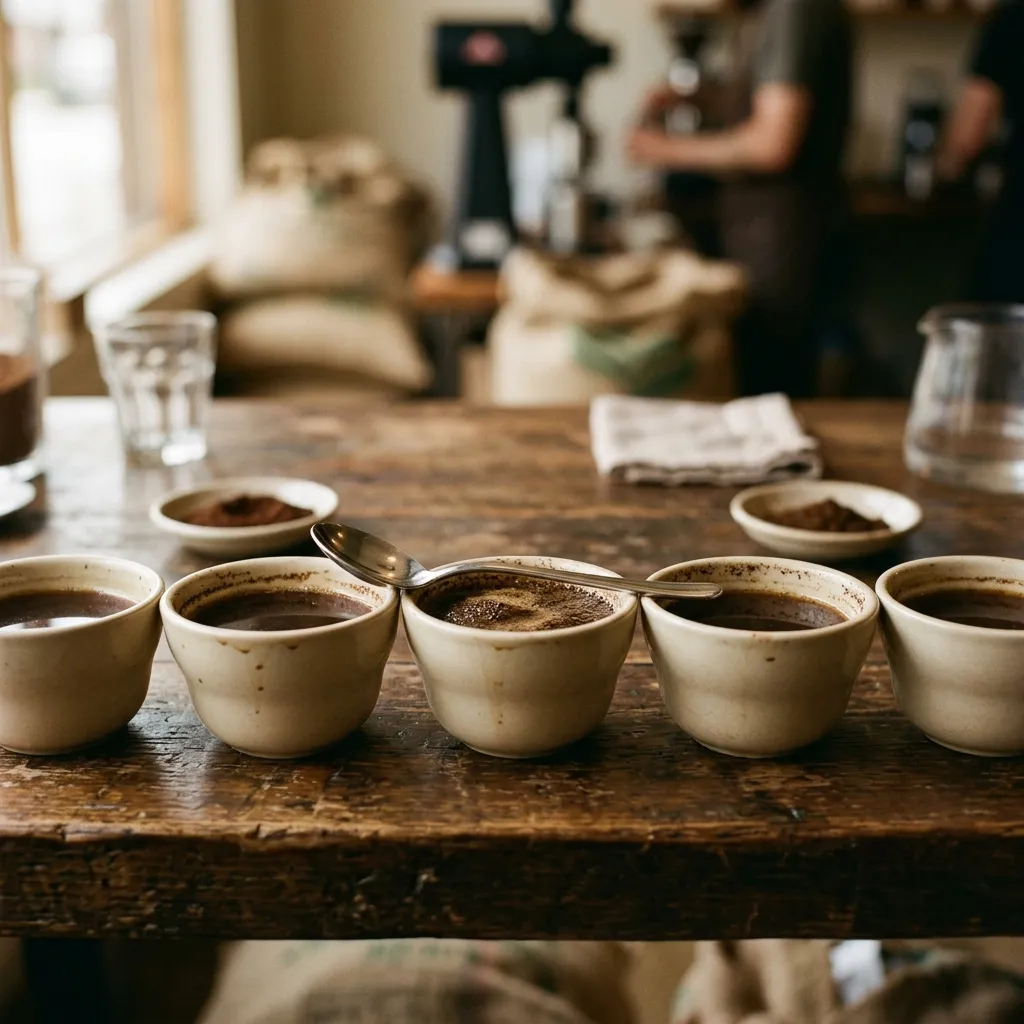
Home coffee cupping - score coffee like a professional
Cupping is how roasters and buyers evaluate coffee all over the world - and, interestingly, the simplest brewing method you will find. No machine, no pour-over, no gear: coffee, hot water, a spoon. And it is the fastest route to compare several coffees side by side and learn to recognise how one differs from another. You can do it on your kitchen counter.
Why cup at all
Cupping standardises the conditions - every coffee gets exactly the same amount of water, ground the same way, at the same temperature. That way the differences you hear come from the coffee, not from brewing one stronger than another. It is a pure taste test, ideal for comparisons: two origins, two roast levels, two roasters side by side.
What you need
- Several cups or glasses of the same size (one per coffee, ideally 2 each).
- A scale, a grinder, a kettle.
- Two spoons: one for tasting, one for skimming the crust.
- The coffees you want to compare.
Step by step
- Weigh the coffee - classically about 8.25 g per 150 ml of water, but it is enough to keep the same ratio for every cup (say 11 g per 200 ml). The key is that it is identical for all.
- Grind medium-coarse, fresh, right before pouring. The same grind for each coffee - a reminder in grind size.
- Smell the dry coffee in the cup - that is the first aroma.
- Pour in hot water (about 93 degrees), all the coffee at once. A crust of grounds forms on top.
- After 4 minutes break the crust with a spoon, stirring once, and bring your nose close - this is the strongest, most beautiful moment of aroma.
- Skim off the foam and grounds from the top with two spoons.
- Once it cools to a pleasant temperature, slurp the coffee off the spoon - a loud slurp sprays it across your whole palate. There is no elegance here, only effectiveness.
What to look for
Compare the coffees in turn on the same axes:
- Aroma - flowers, fruit, nuts, chocolate, spice.
- Acidity - bright and citrusy or gentle; it is not a flaw but a character, which we cover in why coffee tastes sour.
- Sweetness and body - light and tea-like or thick and syrupy.
- Aftertaste - clean and long or short, how long it holds.
Taste the coffee also as it cools - while cooling it reveals new notes, and faults become more obvious. Where these differences come from in the first place we unpack in where coffee gets its flavour.
Note and overlay the profiles
The point of cupping is comparison, and you will not remember a comparison without notes. In GustoNote you record each coffee separately, then overlay their sensory profiles on one chart - acidity, sweetness, body and aroma line up side by side and you see at once which coffee wins at what. The aroma wheel (based on the SCA wheel) suggests words, and after a few cupping sessions you start catching nuances you could not hear before. This is exactly how the pros train.