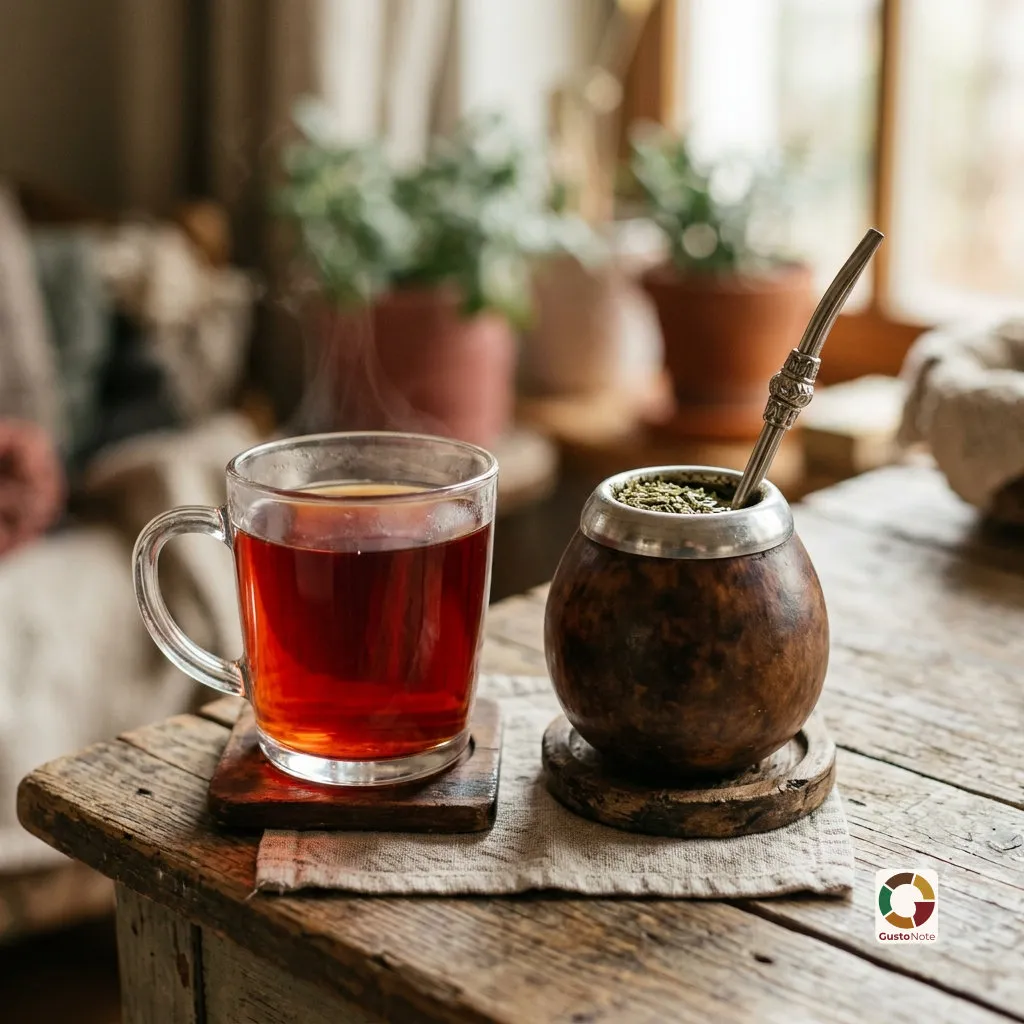
Rooibos and yerba mate - alternatives to tea from two ends of the world
Rooibos and yerba mate are two of the best-known alternatives to classic tea, often thrown together as herbal infusions. That is a big oversimplification, though, because while neither is a real tea, one absolutely key thing divides them: caffeine. Rooibos has none at all, while yerba mate stimulates almost like coffee. They also come from two opposite ends of the world and have completely different characters. They are worth knowing, because they are a great addition to the tea shelf, as long as you know what to expect from them.
First, let us correct a myth
Let us start with an important correction, because these two drinks are sometimes mistakenly grouped as caffeine-free alternatives. Only rooibos is caffeine-free. Yerba mate contains plenty of caffeine, on average around 80 milligrams per cup, roughly as much as coffee. This is a fundamental difference that decides when to reach for them. Neither is a real tea, because that comes only from the Camellia sinensis shrub, which I cover in herbal and fruit - why it is not real tea.
Rooibos, the red bush from Africa
Rooibos, pronounced roy-bos, comes from South Africa, where it grows only in the mountainous fynbos region. It is a legume whose leaves, after oxidation, take on the characteristic red-brown colour, hence the name red bush and the casual term red tea.
The most important features of rooibos are:
- No caffeine, which makes it ideal for the evening, for children and for people avoiding stimulation.
- Low tannin content, so rooibos does not turn bitter even with long brewing, unlike real tea.
- A mild, sweetish, slightly nutty flavour with notes of vanilla and honey, and a wealth of antioxidants.
There is also green rooibos, the unoxidised version, with a fresher, more grassy flavour.
Yerba mate, the drink of South America
Yerba mate comes from South America, mainly Argentina, Brazil and Paraguay, where it is a true national drink, consumed daily by most of the population. It is made from the leaves of the holly plant, a completely different plant from the tea shrub.
The most important features of mate are:
- A clear caffeine content, giving energy and focus. Interestingly, mate contains, alongside caffeine, other related compounds, so its stimulation is sometimes described as more balanced and longer-lasting than the sudden surge from coffee.
- A grassy, earthy, slightly smoky and bitterish flavour, strong and characterful.
- A traditional way of drinking from a vessel called a gourd, through a metal straw with a strainer, called a bombilla, often among friends who share one vessel.
It is a drink for those looking for a stimulation different from coffee or tea. I cover how caffeine works and why it stimulates differently in different drinks in caffeine in tea.
How to brew them
Both drinks are quite forgiving, unlike delicate green tea. Rooibos can be brewed with boiling water and steeped for a long time, even a dozen or so minutes, because it will not turn bitter, and long brewing draws out its sweetness and properties. Yerba mate is traditionally brewed with water that is not boiling but hot, around 70 to 80 degrees, so as not to draw out excessive bitterness, and brewed many times, topping up the water on the same portion of leaves. I cover matching temperature and time to real teas in how to brew tea.
How to explore them
The best way to understand these two drinks is to treat them as a complement, not a replacement for tea: rooibos as a mild, caffeine-free drink for the evening, and yerba mate as an energising, earthy alternative to coffee for the day. In GustoNote you note the type, brewing method and your impressions of every infusion, and after a few entries you will see when and which one you reach for. It turns two exotic curiosities into a conscious element of your drink map. I describe the whole world of real tea in types of tea.