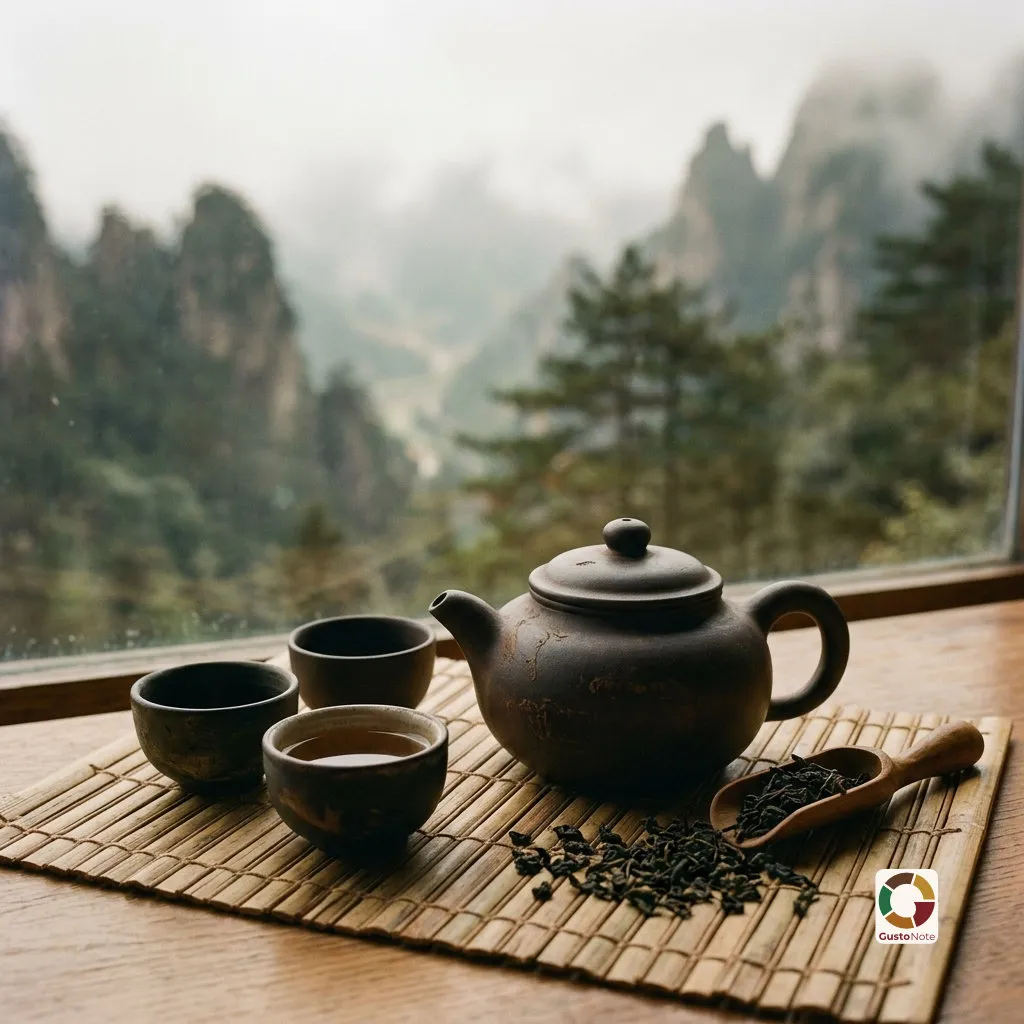
China - the cradle of tea and its styles
If you want to understand tea, you have to start with China. It was there, over two thousand years ago, that the culture of drinking tea was born, and it is there that all six great types are still made: white, green, yellow, oolong, black and dark, that is, pu-erh. China is not only the largest tea producer in the world but also its spiritual homeland, a country of countless regions, varieties and traditions. It is worth knowing this map, because understanding the Chinese regions is the key to understanding tea in general.
The cradle of tea
China is widely recognised as the place the tea shrub, Camellia sinensis, comes from. Its homeland is considered to be especially Yunnan province in the south-west of the country, and China was the first state to begin cultivating and drinking tea. It was here that all the methods of processing the leaf were invented, giving rise to the six types of tea. I cover this whole division in types of tea. Other tea countries, like Japan or India, took tea precisely from China.
The four great regions
China is traditionally divided into four great tea regions, each with its own climate and specialties:
Huanan, the south
This is the warm, rainy southern region, covering provinces including Fujian, Guangdong and Guangxi. A long growing season, up to ten months, favours a wealth of styles. Fujian is a real treasure trove: it is the source of white tea, jasmine tea, smoky Lapsang Souchong and famous oolongs like Tieguanyin and the legendary Da Hong Pao from the rocky Wuyi mountains. I cover oolongs in oolong.
Jiangnan, the heart of green tea
This is the region of the middle and lower reaches of the Yangtze, covering the provinces of Zhejiang, Anhui and parts of neighbouring ones. This is where the heart of Chinese green tea beats. From Zhejiang province comes the most famous green tea in the world, Longjing, or Dragon Well, with its nutty, toasty flavour. From Anhui province, specifically Yellow Mountain, come more classics like Huangshan Maofeng. I cover green teas in green tea.
Xinan, the south-west
This is the south-western region, covering above all Yunnan province as well as Sichuan and Guizhou. Thanks to a moderate, stable climate and cultivation at various altitudes, it gives prized black and green teas, but above all it is famous for pu-erh, the fermented and ageing tea I cover in pu-erh. It is from Yunnan, the cradle of tea, that the deepest, most forest-like styles come.
Jiangbei, the far north
This is the northernmost region, where the climate becomes too cold and dry for most teas. Mainly small-leaf varieties grow here, and green tea dominates. Interestingly, this climatic weakness can be a strength: low temperatures make the leaves grow more slowly and develop a more pronounced, sweeter flavour.
Why explore Chinese teas
China offers unrivalled variety: from delicate white, through nutty greens and floral oolongs, to deep pu-erh. Green tea dominates here, but practically every style has its Chinese roots. Drinking tea is also a whole culture in China, with the traditional gongfu art of brewing, which I mention in multiple tea infusions.
How to explore them
The best way to start exploring Chinese teas is to try one from each of the most important categories: a green Longjing, a Wuyi oolong and a Yunnan pu-erh. You will feel how huge the span of flavours from a single country is. In GustoNote you note the region, type and your impressions of every Chinese tea, and after a few dozen entries you will see which regions and styles suit you best. It turns the huge, intimidating world of Chinese tea into an organised, personal map of flavour. You will find a full overview of tea types in types of tea.