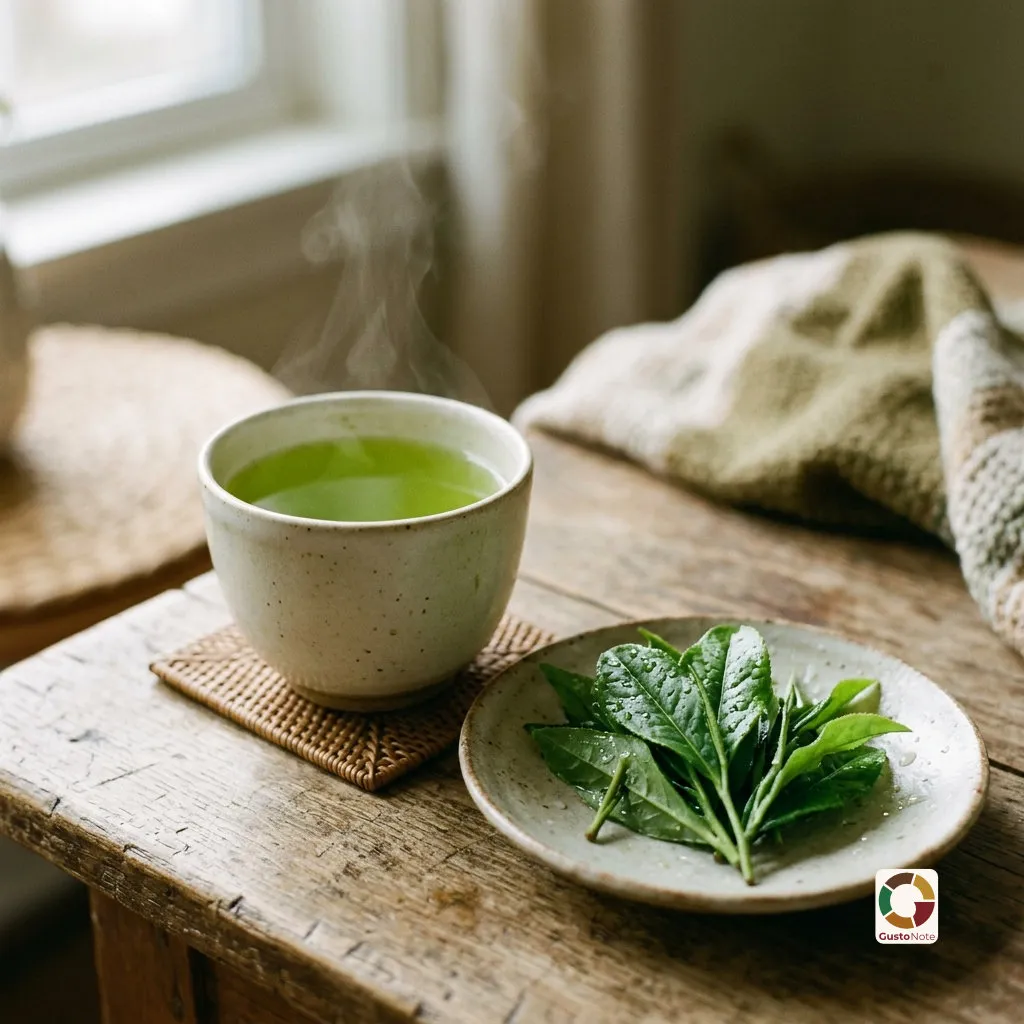
Japan - sencha, matcha, shade and steam
Anyone used to Chinese green tea often gets lost at the first sip of a good Japanese sencha. The flavour is intensely green, grassy, almost vegetal, and then something hard to name appears: a broth-like, savoury depth that the Japanese call umami. It is neither an accident nor a fault. Japanese tea tastes different because it is made differently, and the two key secrets are steam instead of pan-firing and cultivation in shade. Once you understand them, the whole category falls into a logical whole.
Steam, not a pan
The first fundamental difference concerns how the oxidation of the leaf is stopped. Every green tea must be heated quickly after harvest to deactivate the enzymes and preserve the green colour and fresh character. It is the step that decides whether the tea stays green or starts to brown. I cover oxidation itself in tea oxidation.
China traditionally fires the leaves in a hot pan or drum, which gives nutty, toasty, sometimes faintly smoky notes. Japan took a different path and heats the leaves with steam, usually for a few dozen seconds. Steam does not scorch the leaf but par-cooks it, so it keeps an intensely green colour and a fresh, plant-like aroma. That is why Japanese tea is so vividly green in the cup and tastes more like fresh vegetables or freshly cut grass than roasted nuts.
The steaming time matters and splits sencha into subtypes. Lightly steamed, called asamushi, gives a clear, delicate, floral tea. Steamed longer, called fukamushi, has more broken leaves, a cloudier, deep green liquor and a fuller, denser, sweeter flavour. It is the first parameter worth catching when trying different Japanese teas.
Shade, the secret of umami
The second, even more important secret is cultivation in shade. The noblest Japanese teas grow under cover that is placed over the bushes for several weeks before harvest. Traditionally these were mats of bamboo or straw, today more often black mesh. This technique, in Japanese ōishita, that is cultivation under cover, completely changes the chemistry of the leaf.
The mechanism is fascinating and worth understanding, because it explains the whole flavour. In the tea leaf there is an amino acid called L-theanine, responsible for the umami taste and the gentle, focused action of caffeine. In full sun the plant converts theanine into catechins, the compounds that give astringent bitterness and grip. When we shade the bush, photosynthesis slows and the plant converts far less theanine. The result: the leaf keeps plenty of umami and forms little bitterness.
In other words, shade shifts the tea from grassy astringency towards a sweet, broth-like depth. The longer the bush grows in shade, the more umami and the less bitterness. It is this single treatment that splits Japanese green teas into a family of rising intensity.
The ladder of shade: from sencha to matcha
When we arrange Japanese teas by the time spent in shade, a clear ladder emerges, on which each rung is richer in umami than the one below.
- Sencha grows in full sun, without shading. It is the most popular Japanese tea, fresh, clean, grassy, with a distinct, refreshing astringency and light bitterness. It is the starting point and the everyday tea of Japan.
- Kabusecha is shaded briefly, about two weeks before harvest. The effect is intermediate: softer, sweeter and more umami than sencha, but still lighter than gyokuro. It is a great first step for someone who wants to feel the effect of shade.
- Gyokuro is the peak of leaf teas, shaded for about three weeks. It gives a liquor of intense, almost bouillon-like umami, sweet, smooth, with a deep green colour and very low bitterness. It is brewed briefly and at low temperature to draw out the sweetness.
- Matcha is shaded the longest, about four weeks, then dried and ground into a very fine powder from the whole leaf. So you drink the entire powdered leaf, not just an infusion, which gives the maximum of umami, colour and caffeine. I cover matcha itself in matcha.
This ordering is the simplest key to all Japanese tea: the higher up the ladder of shade, the more umami, sweetness and depth, and the less grassy astringency.
Why Japanese tea can turn bitter
If umami sounds so tempting, why do so many people complain that their Japanese tea came out bitter and astringent? Most often it is the brewing, not the tea. Japanese green teas are very sensitive to temperature. Doused with boiling water, they release excess catechins and caffeine, that is exactly the bitterness and astringency, and destroy the subtle umami.
The secret is water much cooler than for black tea. Sencha likes water in the low seventies Celsius, and gyokuro cooler still, around the mid fifties, with a short brewing time. The nobler and more shaded the tea, the cooler the water. It is one of the most important lessons in brewing tea: hotter water does not mean better tea. I cover where bitterness comes from in why your tea tastes bitter, and brewing itself in how to brew tea.
Caffeine and calm energy
Japanese green tea, especially the shaded kind, has one more interesting trait. The combination of caffeine and a high content of L-theanine gives a stimulation different from coffee: calmer, more focused, without a nervous spike. Theanine softens the sharp action of caffeine, which many describe as a state of alert calm. That is why matcha and gyokuro, the richest in theanine, have accompanied meditation and the tea ceremony for centuries. I cover how much caffeine is in tea in caffeine in tea.
A small map of Japanese teas
It is worth knowing a few more names you will meet when reaching for Japanese tea. Bancha is a later, coarser harvest of sencha, cheaper and milder, with less caffeine. Genmaicha is sencha or bancha blended with toasted rice, giving a warm, grainy, nutty flavour. Hojicha is a roasted tea, brown, low in caffeine and with a pleasant caramel note, the one Japanese exception to the steam rule, because here the leaf is deliberately roasted. Each of them is a different point on the flavour map of the same bush.
How to explore them
The best way to understand Japanese tea is to set up a small tasting along the ladder of shade: sencha, kabusecha and gyokuro side by side, brewed carefully in suitably cool water. From sip to sip you will feel grassy freshness give way to sweet, broth-like umami. In GustoNote you record the water temperature, brewing time, intensity of umami and bitterness and your impressions of each tea, and after a few entries you will see exactly where on this ladder your favourite flavour lies. It turns a category that is confusing at first into a clear, personal map. You will find a full overview of green tea types in green tea types.